

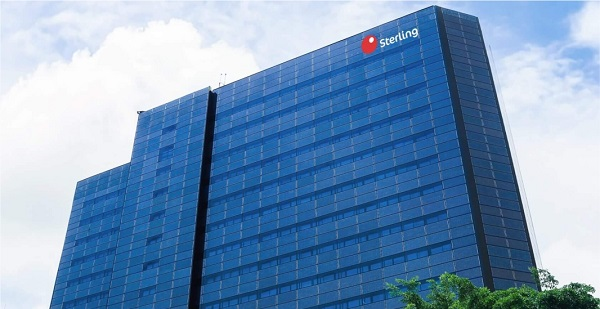
By Kingsley Ani
Sterling Financial Holdings Company Plc (Sterling HoldCo) will seek shareholder approval at its Annual General Meeting (AGM) scheduled for June 9 to raise up to $400 million in fresh capital as part of a broader balance sheet restructuring and growth strategy. In a notice signed by Company Secretary, Mr. Sunny Kanabe, the group disclosed that the capital could be raised in naira, dollars, or other currencies through debt instruments, ordinary shares, preference shares, bonds, global depositary receipts, or hybrid instruments across Nigerian and international capital markets.
The proposed issuance, which supplements approvals secured at the company’s July 11, 2025 AGM, may occur through public offers, private placements, rights issues, or other board-approved structures subject to regulatory clearance. Simultaneously, shareholders will vote on a 10-for-1 share consolidation that would reduce issued ordinary shares from 68.5 billion to 6.85 billion, alongside a capital reduction and reconstruction programme.
The move follows Sterling HoldCo’s strong 2025 audited performance, which showed profit before tax rising 89.19 percent year-on-year to N86.78 billion, while profit after tax increased 74.74 percent to N76.33 billion.
DECISION HIGHLIGHT
Sterling HoldCo is combining fresh capital mobilisation with share capital restructuring to optimise its balance sheet, improve capital efficiency, and strengthen its long-term funding capacity amid evolving banking sector capital requirements and growth ambitions.
DECISION MEMO
Sterling HoldCo’s proposed transaction reflects a strategic repositioning exercise rather than a standalone fundraising initiative. The simultaneous pursuit of capital injection, share consolidation, and capital reduction suggests a deliberate effort to recalibrate valuation structure, funding flexibility, and capital market positioning ahead of a more demanding banking and regulatory environment.
The proposed $400 million raise indicates management’s preference for optionality across both debt and equity markets. By authorising multiple instruments and currencies, the group is preserving flexibility to respond to changing investor appetite, interest rate conditions, and foreign exchange dynamics. The inclusion of international capital market access also signals an ambition to diversify funding sources beyond domestic liquidity pools.
The share consolidation component carries both technical and signalling implications. Reducing the number of outstanding shares through a 10-for-1 restructuring may improve nominal share perception, reduce speculative fragmentation, and reposition the stock for institutional participation. However, the accompanying cancellation of 61.65 billion shares and creation of a reconstruction reserve account also indicate a broader capital optimisation process aimed at cleaning up balance sheet structure without directly impairing shareholder proportional ownership.
Importantly, the capital exercise follows a year of accelerated earnings growth. Sterling’s strong profit expansion provides management with stronger justification for raising additional capital from a position of relative operational momentum rather than financial distress.
The broader context remains Nigeria’s tightening banking capital environment, where financial institutions are increasingly balancing recapitalisation pressures, inflationary operating costs, foreign exchange volatility, and rising impairment risks. Sterling’s approach suggests a preference for pre-emptive restructuring before external pressures become binding.
DATA BOX
- Proposed capital raise: up to $400 million
- AGM date: June 9
- Capital instruments proposed:
- Bonds
- Ordinary shares
- Preference shares
- Global depositary receipts
- Hybrid debt/equity structures
- Capital raising channels:
- Public offer
- Private placement
- Rights issue
- Share consolidation ratio: 10 existing shares to 1 new share
- Existing ordinary shares: 68.5 billion
- Proposed post-consolidation shares: 6.85 billion
- Shares proposed for cancellation/extinguishment: 61.65 billion
- FY2025 profit before tax: N86.78 billion, up 89.19 percent
- FY2025 profit after tax: N76.33 billion, up 74.74 percent
- FY2025 gross earnings: N486.80 billion, up 44.37 percent
WHO WINS / WHO LOSES
Who Wins:
- Sterling Financial Holdings Company Plc if capital mobilisation strengthens lending and expansion capacity
- Institutional investors favouring cleaner capital structures and stronger earnings growth
- Long-term shareholders if restructuring improves valuation quality and capital efficiency
- Debt investors seeking diversified banking sector exposure
Who Loses:
- Retail investors vulnerable to misunderstanding consolidation mechanics
- Shareholders affected by fractional entitlement adjustments
- Existing investors facing potential dilution under future equity issuance tranches
- Smaller market participants reliant on lower nominal share pricing
POLICY SIGNALS
- Nigerian financial institutions are accelerating capital restructuring ahead of stricter sector-wide capital expectations
- Hybrid funding structures are becoming increasingly central to banking recapitalisation strategies
- Capital optimisation is shifting beyond equity issuance into broader balance sheet engineering
- Banks are increasingly using international capital market access to diversify liquidity sources
- Regulatory and market conditions are incentivising pre-emptive recapitalisation rather than reactive restructuring
INVESTOR SIGNAL
The proposed transaction signals management confidence in Sterling HoldCo’s medium-term growth trajectory and earnings sustainability. Strong profitability provides a more credible platform for capital mobilisation, potentially improving investor receptivity.
The flexibility embedded within the fundraising structure may appeal to both domestic and offshore investors seeking exposure to Nigeria’s banking sector without reliance on a single instrument class. However, investor sentiment will likely depend on pricing discipline, dilution management, and clarity regarding deployment of proceeds.
The share reconstruction programme may also improve institutional perception if it enhances market liquidity quality and strengthens capital efficiency metrics.
RISK RADAR
- Shareholder resistance to consolidation or dilution concerns
- Foreign exchange volatility affecting offshore capital raising plans
- Weak market conditions reducing investor appetite for banking sector issuances
- Execution risks across multi-tranche funding structures
- Regulatory approval delays across domestic and international markets
- Potential market perception that restructuring reflects hidden balance sheet pressure despite earnings growth
Discover more from StakeBridge Media
Subscribe to get the latest posts sent to your email.