

By Jennete Ugo Anya
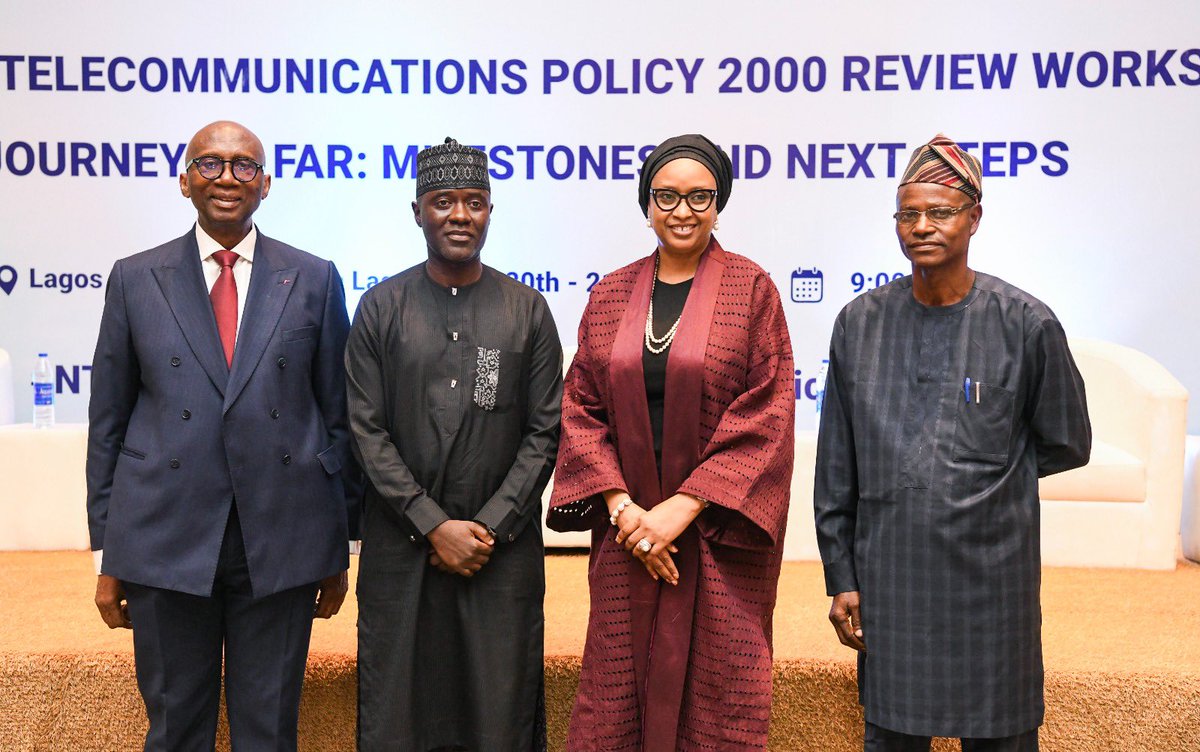
The Nigerian Communications Commission (NCC) has commenced a two-day stakeholders’ workshop in Lagos to review Nigeria’s 26-year-old National Telecommunications Policy (NTP) 2000, signalling a major regulatory reassessment of the country’s digital economy architecture. The recent review convened regulators, policymakers, industry operators, academics and development partners to evaluate the policy that liberalised Nigeria’s telecoms sector and to redesign its framework around emerging technologies including Fifth Generation (5G), artificial intelligence, satellite broadband, cloud infrastructure, cybersecurity and the Internet of Things (IoT).
The Executive Vice Chairman and Chief Executive Officer of NCC, Aminu Maida, said that the exercise represented “a strategic national conversation on the future of Nigeria’s telecommunications and digital ecosystem.” Maida noted that the sector had evolved from fewer than 500,000 active telephone lines under the monopoly of the defunct Nigerian Telecommunications Limited (NITEL) in 2000 into a critical national infrastructure powering banking, fintech, e-commerce, healthcare, education and digital identity systems.
According to Maida, regulation has now moved beyond market liberalisation into collaborative digital governance involving institutions including the Nigeria Data Protection Commission (NDPC), Central Bank of Nigeria (CBN), Federal Competition and Consumer Protection Commission (FCCPC), National Information Technology Development Agency (NITDA) and National Identity Management Commission (NIMC).
Special Adviser to the President on Policy and Coordination, Hadiza Bala Usman, said that the review aligns with President Bola Ahmed Tinubu’s digital economy agenda, stressing that digital infrastructure remains central to governance efficiency, financial inclusion and economic competitiveness.
DECISION HIGHLIGHT
The NCC is effectively attempting to reposition telecommunications from a standalone commercial sector into the foundational infrastructure layer for Nigeria’s wider digital economy. The review acknowledges that the NTP 2000 successfully opened the sector to private capital and competition, but has become structurally outdated for an economy increasingly dependent on data governance, cloud systems, AI-enabled services and digital financial infrastructure.
Maida stated that telecommunications “should no longer be viewed as a stand-alone sector but as critical infrastructure driving national productivity and economic growth.”
Former Executive Vice Chairman of NCC, Ernest Ndukwe, said that emerging realities including “5G networks, artificial intelligence, cloud computing, and digital services now require fresh policy directions to keep Nigeria globally competitive.”
DECISION MEMO
The policy review reflects a broader recognition that Nigeria’s digital economy is now outgrowing the institutional assumptions that shaped telecoms liberalisation in the early 2000s. The original framework primarily focused on market entry, competition and voice connectivity. The new challenge is systemic coordination across data protection, financial systems, cybersecurity, digital identity and platform governance.
The NCC’s recalibration therefore appears less about telecoms regulation alone and more about constructing a unified governance architecture for a digitised economy. The increasing overlap between telecoms infrastructure and sectors such as fintech, cloud computing and digital public services has created regulatory interdependence that older frameworks were not designed to manage.
The inclusion of agencies such as NDPC, CBN, FCCPC, NITDA and NIMC signals that future telecoms regulation in Nigeria may evolve into a multi-agency digital governance model where infrastructure, competition, privacy and financial regulation become increasingly interconnected.
Oladojo Olawumi of NITDA stressed that “inter-agency collaboration” would remain essential for building “a secure and inclusive digital economy,” while representatives of NDPC emphasised stronger data governance and digital trust frameworks.
DATA BOX
- National Telecommunications Policy introduced in 2000
- Fewer than 500,000 active telephone lines existed before liberalisation
- Nigeria’s population exceeded 120 million at policy inception
- Workshop duration: two days in Lagos
- Key technologies under review: 5G, AI, IoT, satellite broadband, cloud infrastructure, cybersecurity
- Regulatory institutions involved: NCC, NDPC, CBN, FCCPC, NITDA, NIMC
- Technical sessions focused on digital divide, cybersecurity resilience, global regulatory standards and policy reform
WHO WINS / WHO LOSES
Who Wins:
- Telecoms operators expanding into digital infrastructure services
- Fintech, cloud and AI-driven businesses requiring regulatory clarity
- Consumers benefiting from broader digital connectivity and service integration
- Government agencies pursuing interoperable digital governance systems
- Cybersecurity and data governance service providers
Who Loses:
- Legacy regulatory structures unable to adapt to digital convergence
- Operators resistant to stronger compliance and data governance obligations
- Underserved regions if infrastructure expansion remains commercially concentrated
POLICY SIGNALS
The federal government is signalling a transition from telecoms liberalisation policy into integrated digital economy governance. Future regulation is likely to focus on cybersecurity, digital trust, data sovereignty, infrastructure resilience, spectrum efficiency and cross-agency coordination.
The NCC is also positioning itself as a central coordinating institution within Nigeria’s digital transformation agenda rather than merely a telecoms market regulator.
INVESTOR SIGNAL
The review strengthens indications that Nigeria intends to deepen investment opportunities across broadband infrastructure, data centres, cloud services, AI systems, digital payments and cybersecurity. Clearer policy direction could improve investor confidence in long-term digital infrastructure deployment.
The growing convergence between telecoms and financial technology also suggests stronger institutional support for digital commerce ecosystems.
RISK RADAR
Regulatory fragmentation remains a major risk. Expanding institutional overlap between telecoms, finance, data protection and competition regulation could create compliance duplication and jurisdictional uncertainty if coordination mechanisms remain weak.
Infrastructure inequality also remains unresolved. Without sustained investment in rural connectivity, digital literacy and energy reliability, the benefits of advanced digital infrastructure may remain unevenly distributed across Nigeria.
Discover more from StakeBridge Media
Subscribe to get the latest posts sent to your email.