

By Ayo Susan
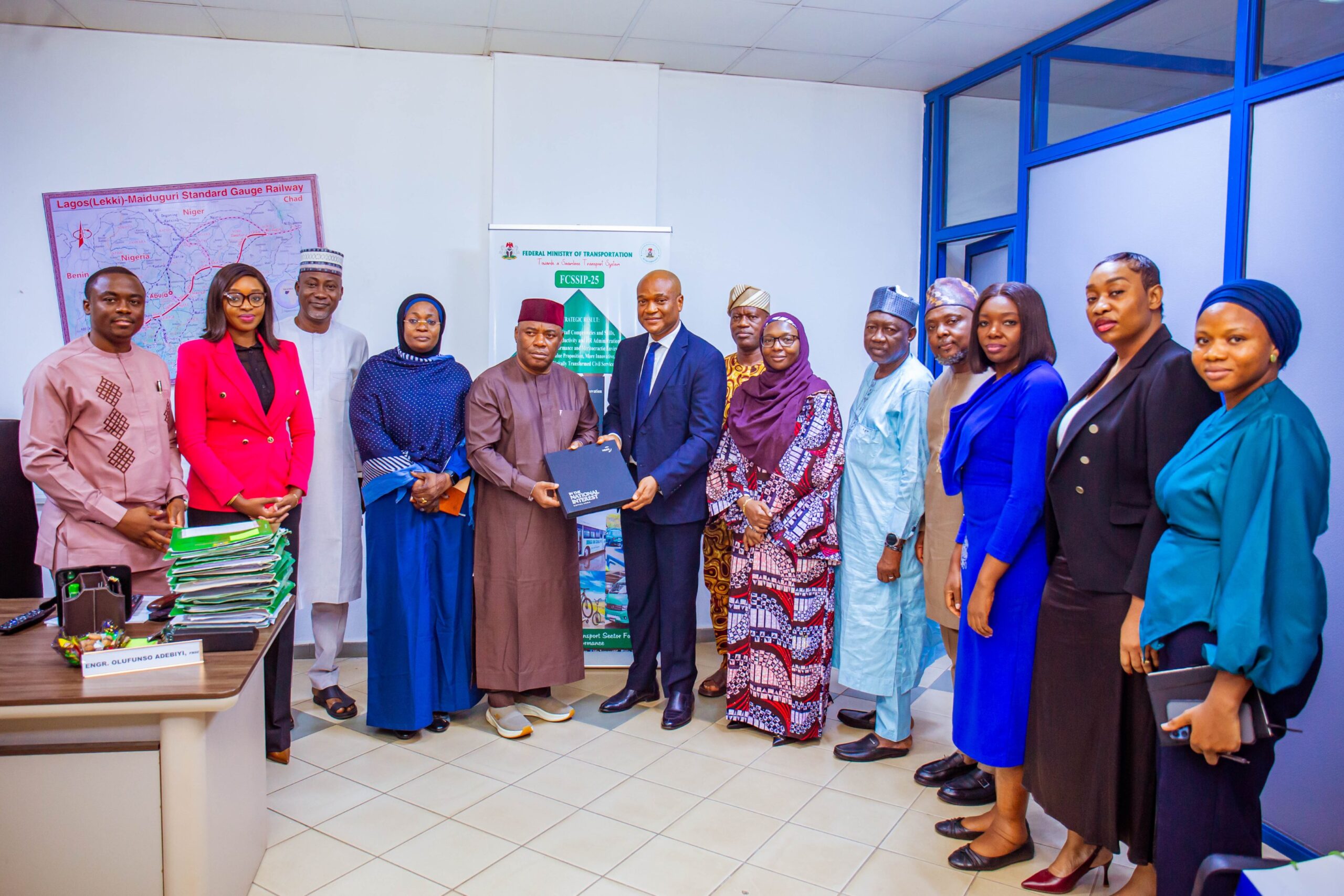
The Nigerian Economic Summit Group (NESG), through its Infrastructure and Allied Services Policy Commission, recently held a strategic engagement with the Permanent Secretary of the Federal Ministry of Transportation, Engr Funsho Adebiyi, to strengthen collaboration on Nigeria’s transport infrastructure agenda. The meeting, held as part of NESG’s ongoing policy advocacy and stakeholder engagement programme, focused on addressing structural challenges within the transport sector, identifying emerging opportunities and developing practical pathways towards a more integrated, efficient and sustainable transportation system. The NESG delegation was led by Mr. Nnanna Ude, Board Director, and included Mrs. Saadiya Aliyu, Facilitator of the Infrastructure and Allied Services Policy Commission, and Engr. Gabriel Ekanem, Thematic Lead for Water and Sanitation.
According to the NESG, the objective is to deepen partnerships capable of “developing an efficient, integrated, and sustainable transportation system that drives economic growth, enhances mobility, and improves national competitiveness.”
DECISION HIGHLIGHT
The engagement signals an effort to strengthen policy coordination between the public and private sectors in order to accelerate transport infrastructure reforms and improve connectivity across Nigeria’s economic corridors.
DECISION MEMO
Although no specific project, funding package or policy directive emerged from the meeting, its significance lies in the growing recognition that transport infrastructure challenges are increasingly constraining economic productivity, trade competitiveness and regional integration.
Nigeria’s transportation ecosystem remains characterised by fragmented modal systems, inadequate logistics integration, infrastructure deficits and operational inefficiencies. These constraints continue to increase the cost of moving goods, people and services across the economy.
The NESG’s engagement with the Ministry of Transportation reflects a broader policy trend in which private-sector policy institutions are seeking a more active role in shaping infrastructure priorities, implementation frameworks and sector reforms.
The emphasis on integration is particularly important. Historically, road, rail, maritime and inland transport systems have often developed in isolation, limiting the economic benefits of infrastructure investments. An integrated transport strategy seeks to improve connectivity between these modes, enhance logistics efficiency and reduce transaction costs.
The meeting also underscores the growing shift from infrastructure planning as a government-only responsibility towards collaborative models involving policymakers, industry stakeholders and policy advocacy institutions.
The deeper implication is that infrastructure competitiveness is increasingly being viewed as a prerequisite for economic competitiveness.
DATA BOX
Key Institutions
- Nigerian Economic Summit Group
- Infrastructure and Allied Services Policy Commission
- Federal Ministry of Transportation
Principal Participants
- Engr Funsho Adebiyi, Permanent Secretary, Federal Ministry of Transportation
- Mr Nnanna Ude, Board Director, Nigerian Economic Summit Group
- Mrs Saadiya Aliyu, Facilitator, Infrastructure and Allied Services Policy Commission
- Engr Gabriel Ekanem, Thematic Lead, Water and Sanitation
Strategic Focus Areas
- Transport infrastructure development
- Sector reform
- Mobility enhancement
- Logistics efficiency
- Economic competitiveness
- Public-private collaboration
- Sustainable transport systems
Issues Discussed
- Sector challenges
- Emerging opportunities
- Integrated transport planning
- Infrastructure transformation pathways
WHO WINS / WHO LOSES
Winners
- Businesses dependent on efficient logistics and freight movement.
- Manufacturers and exporters facing high transportation costs.
- Commuters and transport users if reforms improve mobility.
- Investors seeking improved infrastructure certainty.
- Regional economies benefiting from stronger connectivity.
Potential Losers
- Sectors benefiting from inefficiencies and fragmented transport systems.
- Businesses unable to adapt to future infrastructure and logistics reforms.
- Regions that remain disconnected from major transport corridors.
POLICY SIGNALS
- Government is increasingly open to structured engagement with private-sector policy institutions.
- Transport connectivity remains a strategic national development priority.
- Infrastructure reform is moving towards integrated multimodal planning.
- Stakeholder collaboration is becoming an important feature of policy formulation.
- Economic competitiveness is increasingly linked to logistics and mobility performance.
INVESTOR SIGNAL
The engagement reinforces continued policy attention on transport infrastructure as a catalyst for economic growth. While no immediate investment commitments were announced, the discussions indicate growing alignment between policymakers and private-sector stakeholders on the need for infrastructure modernisation. For investors, such engagements often precede reforms, project pipelines and institutional partnerships capable of improving the operating environment for infrastructure finance and logistics-related investments.
RISK RADAR
- Policy discussions not translating into implementation.
- Funding constraints affecting infrastructure execution.
- Institutional coordination challenges across transport agencies.
- Delays in regulatory reforms.
- Weak integration between transport modes.
- Infrastructure maintenance deficits reducing long-term efficiency.
- Persistent logistics bottlenecks undermining competitiveness gains.
The strategic value of the engagement lies less in immediate outcomes and more in its contribution to policy alignment. For Nigeria, the long-term challenge remains converting dialogue, institutional cooperation and infrastructure ambitions into measurable improvements in connectivity, logistics efficiency and economic productivity.
Discover more from StakeBridge Media
Subscribe to get the latest posts sent to your email.