

By Hannah Yemisi
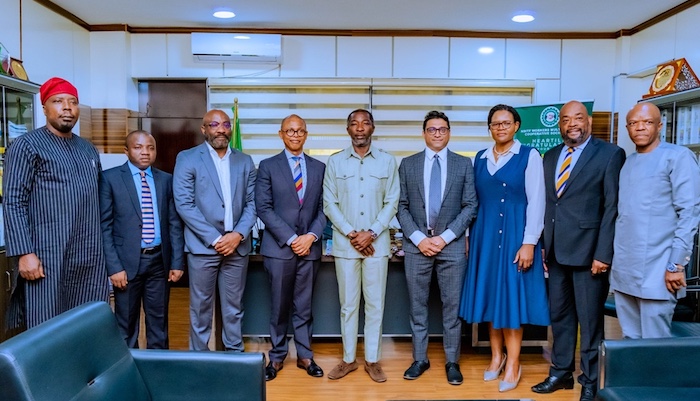
The Nigeria Social Insurance Trust Fund (NSITF) and Rand Mutual Assurance (RMA) of South Africa have initiated a strategic partnership aimed at strengthening workers’ compensation, occupational safety and social protection systems across Africa. During a meeting in Abuja, Managing Director and Chief Executive of the Nigeria Social Insurance Trust Fund, Barrister Oluwaseun Faleye, hosted a delegation led by Bilal Adam, Group Chief Executive Officer of Rand Mutual Assurance, where both organisations agreed to deepen collaboration through a proposed Memorandum of Understanding. The partnership will focus on digital transformation, claims administration, rehabilitation, occupational health and safety, research, policy development and institutional capacity building.
DECISION HIGHLIGHT
The two institutions agreed to formalise cooperation through a Memorandum of Understanding, signalling a shift from bilateral engagement to structured institutional collaboration on workers’ compensation and social insurance administration.
DECISION MEMO
The proposed partnership reflects a broader recognition that Africa’s social insurance institutions face increasingly similar challenges as labour markets evolve and occupational risks become more complex. Rather than pursuing isolated reforms, the two organisations are positioning cross-border knowledge exchange as a tool for institutional modernisation.
For the Nigeria Social Insurance Trust Fund, the collaboration provides access to operational experience from one of Africa’s oldest workers’ compensation insurers, particularly in claims management, rehabilitation and prevention systems. For Rand Mutual Assurance, the partnership expands regional influence and creates opportunities to shape emerging best practices beyond South Africa.
Faleye’s emphasis on digital transformation suggests the Fund is looking beyond statutory compensation towards more efficient service delivery. Efficient claims processing, rehabilitation programmes and return-to-work initiatives increasingly determine the effectiveness of compensation schemes as much as legislative frameworks.
The proposed Memorandum of Understanding also signals a growing preference among African public institutions for peer-to-peer institutional partnerships rather than relying exclusively on external development agencies for technical support.
DATA BOX
| Item | Details |
| Institutions | Nigeria Social Insurance Trust Fund and Rand Mutual Assurance |
| Objective | Strengthen social protection and workers’ compensation systems |
| Proposed instrument | Memorandum of Understanding |
| Priority areas | Digital transformation, claims administration, occupational safety and health, rehabilitation, return-to-work programmes, research, policy development, capacity building |
| Employees’ Compensation Scheme focus | Compensation, medical care, rehabilitation and support for workplace injuries, occupational diseases, disability and death |
| Rand Mutual Assurance established | 1894 |
WHO WINS / WHO LOSES
Winners
- Workers who could benefit from improved compensation administration and rehabilitation services.
- Employers through stronger workplace risk management and more efficient compensation systems.
- Both institutions through knowledge transfer and operational collaboration.
Losers
- Inefficient legacy administrative processes if digital reforms are successfully implemented.
- None immediately, as the announcement concerns institutional cooperation rather than regulatory changes.
POLICY SIGNALS
The initiative reinforces a regional policy trend towards harmonising social protection standards through institutional partnerships. It also indicates increasing emphasis on digital administration, occupational safety and rehabilitation as core components of modern workers’ compensation systems rather than treating compensation solely as a post-incident financial obligation.
INVESTOR SIGNAL
Although the agreement does not directly affect capital markets, stronger workplace compensation systems can improve labour market resilience and reduce business uncertainty associated with occupational injury liabilities. The proposed collaboration also supports broader governance reforms that may enhance institutional credibility.
RISK RADAR
- Successful implementation depends on translating the Memorandum of Understanding into measurable programmes.
- Differences in regulatory frameworks may slow policy harmonisation.
- Digital transformation initiatives require sustained funding and technical capacity.
- Long-term outcomes will depend on execution rather than the partnership announcement itself.
Discover more from StakeBridge Media
Subscribe to get the latest posts sent to your email.