

By Johnson Emmanuel
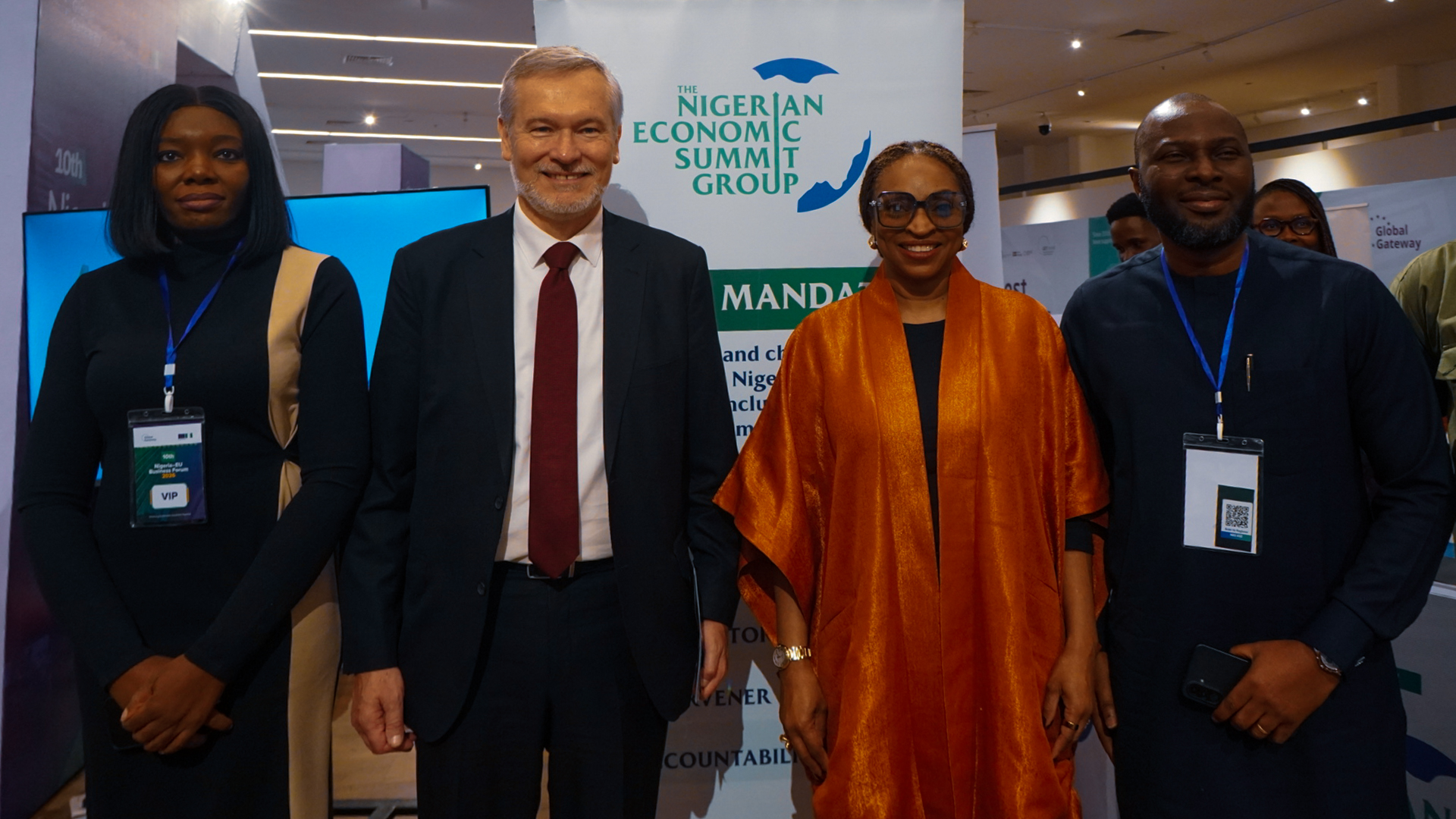
The Nigerian Economic Summit Group (NESG) joined policymakers, investors and business leaders at the 10th Nigeria-EU Business Forum held on 25 June 2026 at the Wole Soyinka Centre for Culture and Creative Arts, National Theatre, Lagos. Under the theme, ‘Enhancing Sustainable Investment Together,’ the forum explored investment opportunities across finance, infrastructure, agriculture, healthcare and the digital economy. Head of Research and Development at the NESG, Dr Joseph Ogebe, presented findings from the NESG Business Confidence Monitor, arguing that Nigeria’s investment constraints are increasingly operational rather than demand-driven. Chief Economist and Director of Research and Development at the NESG, Dr Olusegun Omisakin, stressed that regulatory certainty and policy consistency remain essential for attracting long-term productive investment.
DECISION HIGHLIGHT
The Nigerian Economic Summit Group reinforced the case for execution-led economic reforms, arguing that operational efficiency, regulatory predictability and resilient value chains are now more critical to investment growth than demand stimulation alone.
DECISION MEMO
The Nigerian Economic Summit Group’s intervention shifts the investment conversation from macroeconomic recovery towards implementation quality. While business confidence is improving, the organisation argues that firms remain constrained by structural bottlenecks including energy costs, logistics inefficiencies, financing gaps and supply chain weaknesses.
Dr Joseph Ogebe’s assessment suggests that stronger consumer demand alone will not unlock higher private investment unless businesses can operate more efficiently. Companies investing in local production, workforce capability and resilient supply networks are already demonstrating stronger competitiveness despite persistent cost pressures.
Complementing this view, Dr Olusegun Omisakin positioned regulatory certainty as a prerequisite for sustainable capital formation. Stable policy frameworks reduce investment risk, encourage longer investment horizons and improve confidence among both domestic and international investors.
Collectively, the presentations indicate that Nigeria’s next phase of economic growth depends less on announcing reforms than on consistently implementing them.
DATA BOX
| Item | Details |
| Event | 10th Nigeria-EU Business Forum |
| Theme | Enhancing Sustainable Investment Together |
| Date | 25 June 2026 |
| Venue | Wole Soyinka Centre for Culture and Creative Arts, National Theatre, Lagos |
| Key sectors | Finance, infrastructure, agriculture, healthcare, digital economy |
| NESG research finding | Business confidence recovering despite compressed profit margins |
| Major constraints identified | Energy, supply chains, operating costs, access to finance |
| Policy focus | Regulatory clarity and policy predictability |
WHO WINS / WHO LOSES
Winners
- Businesses investing in resilient supply chains, local production and workforce development.
- Long-term investors seeking predictable regulatory environments.
- Policymakers pursuing evidence-based investment reforms.
Losers
- Businesses dependent on inefficient operating models and fragile supply chains.
- Investment projects vulnerable to regulatory uncertainty and inconsistent policy implementation.
POLICY SIGNALS
The forum reinforces a growing policy consensus that sustainable investment depends on execution quality rather than policy announcements alone. Regulatory stability, operational efficiency and infrastructure improvements are emerging as the principal drivers of private capital mobilisation.
INVESTOR SIGNAL
Improving business confidence offers positive medium-term sentiment, but investors are likely to remain focused on whether Nigeria can deliver predictable regulation, lower operating costs and improved infrastructure. Businesses with strong localisation strategies and resilient value chains may be better positioned to outperform.
RISK RADAR
- Persistent energy and logistics costs could continue to compress corporate margins.
- Regulatory inconsistency remains a deterrent to long-term capital deployment.
- Limited access to affordable finance may slow private sector expansion.
- Weak implementation of reforms could dilute improving business confidence and investment intentions.
Discover more from StakeBridge Media
Subscribe to get the latest posts sent to your email.