

Nigeria’s ambition to build a $1 trillion economy by 2030 faces an electricity challenge. While the Federal Government mobilises billions for infrastructure, gas debts, weak market liquidity and inadequate generation threaten supply. Nigeria is investing in a bigger electricity system without resolving the commercial weaknesses undermining the existing one. Enam Obiosio writes.
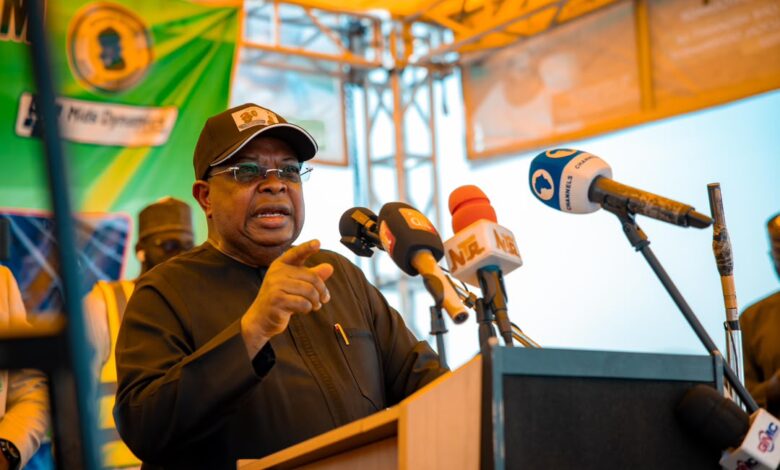
At the sixth annual conference of the Power Correspondents Association of Nigeria in Abuja, stakeholders warned that unpaid gas obligations, generation shortages, transmission constraints and weak payment arrangements continue to threaten electricity supply.
General Manager, Gas Commercial, Nigerian National Petroleum Development Company, Bashiru Adoke, separately said that the electricity market owed more than N630 billion for power generated and consumed.
The Nigerian Independent System Operator attributed reduced grid generation on November 5 to inadequate gas for thermal stations and lower water inflows into hydroelectric reservoirs. The Nigerian National Petroleum Company Limited (NNPCL) said that its gas transportation network remained available, distinguishing transportation from production, commercial supply and actual deliveries.
Government plans to mobilise $18 billion in investment, recapitalise FGN Power Company with at least $1 billion, settle verified legacy debts through a N3.3 trillion intervention and pilot 24-hour electricity supply in Lagos-Ogun and Abuja.
DECISION HIGHLIGHT
The policy choice is whether Nigeria will prioritise infrastructure financing or confront the commercial weaknesses linking gas suppliers, generators, market operators and distributors.
The N3.3 trillion debt intervention, FGN Power Company recapitalisation and transmission investments matter. Without sustainable payments, however, historical liabilities may be cleared while new debts accumulate. Electricity revenue must reach suppliers and infrastructure must deliver dependable power.
DECISION MEMO
Nigeria’s electricity challenge exposes the limits of infrastructure-led reform. Despite generating capacity, transmission projects and investor interest, the market cannot reliably pay for the gas needed to sustain generation.
“There is no robust mechanism for payment of gas supply, because the proceeds from the market is not even enough to pay for gas supply. If you see the invoice monthly for energy generated, it is about 40 percent and the gas takes about 60-75 percent of production cost,” Adoke said.
He stated: “The money is not even enough. That’s why you see in today, the market owes us over N630 billion for power generated and consumed by Nigerians. We should try to establish a robust mechanism for payment of gas or else we would continue to have problems. The government intervention every three or four months won’t solve the issues.”
The payment chain is weak: insufficient electricity revenue prevents generators from consistently paying gas suppliers, threatening deliveries to thermal stations. The N3.3 trillion legacy-debt programme is necessary, but insufficient alone.
Minister of Power, Mr. Joseph Tegbe, said that N1.23 trillion had been raised under the programme to settle verified historical obligations owed to generating companies. Adoke, however, questioned the sustainability of settling old liabilities without addressing current debts.
“The intervention by the government, which is on the legacy debt, is from 2015 to 2025. What about the debt from 2025? It is already accumulating and it is not being addressed. It is a problem,” he said.
Adoke called for investment in non-associated gas, noting that dependence on gas produced alongside crude oil exposes generation to disruptions in oil production. Government incentives will need to attract additional capital.
The financing challenge extends beyond gas. Managing Director of FGN Power Company Limited, Kenny Anuwe, said that the company was seeking at least $1 billion in fresh capitalisation, with the Africa Finance Corporation (AFC) expected to match it. Other financiers are expected to contribute another $18 billion.
“FGN Power Company should be capitalised with at least $1 billion, with the AFC matching it, while other financiers bring in $18 billion,” Anuwe said.
Anuwe also said that government funds over 95 percent of new infrastructure investment.
“That’s not why we privatised,” he said. He disclosed that the Federal Government had invested more than N10 trillion in the sector since privatisation.
“If government did not put that money in, the industry would not be standing,” he also said.
Anuwe further said that FGN Power Company was financing a $2.3 billion portfolio, comprising $1.3 billion from Europe and $1 billion from China, with government holding 15 percent equity in each project. Blended finance and viability-gap funding could attract private capital, provided revenue arrangements, regulation and contract enforcement are credible.
Transmission figures reveal a gap between infrastructure and delivery. Transmission Company of Nigeria (TCN) says wheeling capacity has risen from 7,000MW to 8,700MW. Installed generation is 13,625MW, but peak grid delivery is 5,801.84MW.
TCN’s General Manager, Engineering, Mojeed Akintola, said that the company could only transmit generated electricity and identified right-of-way disputes and vandalism as obstacles. TCN commissioned 82 transformers between January 2024 and November 2025, adding about 8,500MVA, with more than $1.4 billion in multilateral financing.
Tegbe’s four roadmap pillars are grid stabilisation, sector liquidity and sustainability, asset optimisation, and grid expansion. The corridor strategy aligns generation, transmission and distribution across Lagos-Ogun, Benin-Enugu-Port Harcourt and Abuja-Kaduna-Kano.
Tegbe said that the two areas account for more than 50 percent of national electricity demand. However, implementation would depend on “technical readiness and commercial viability”.
“Every serious conversation about Nigeria’s industrial future eventually arrives at the question of power,” he said.
Reliable supply requires generation, gas, transmission, efficient distribution, metering and commercial discipline. The Presidential Metering Initiative has reportedly supplied more than 2.8 million meters to improve collections and reduce losses.
Adoke also warned that prohibitive tariffs could drive consumers towards solar power and independent generation.
“I am scared for this national grid because by the time everybody abandons it and uses solar, I don’t know what the grid will be doing,” he said.
DATA BOX
- Unpaid gas debt: N639 billion.
- Market debt reported by Adoke: more than N630 billion.
- Legacy-debt intervention: N3.3 trillion; N1.23 trillion raised.
- Proposed FGN Power Company capitalisation: $1 billion.
- Expected additional financing: $18 billion.
- FGN Power Company portfolio: $2.3 billion.
- TCN wheeling capacity: 8,700MW.
- Installed generation capacity: 13,625MW.
- Highest grid delivery: 5,801.84MW.
- Customers reportedly metered: more than 2.8 million.
WHO WINS / WHO LOSES
Reliable power benefits consumers, businesses, gas producers, generators and infrastructure investors. Conversely, outages and alternative-energy costs burden consumers; payment defaults expose suppliers, while the economy loses productivity, investment confidence and competitiveness.
POLICY SIGNALS
Government must link legacy-debt settlement to a permanent payment framework. Gas incentives should encourage non-associated production, while market reforms strengthen collections, contractual enforcement and transparent settlement.
Assess the 24-hour pilot against supply hours, generation, collections and payment performance. Transmission projects must address vandalism, right-of-way disputes and safety. Managing Director of the Nigerian Electricity Management Services Agency (NEMSA), Mr. Olusegun Michael, stressed that infrastructure must be safe and regulation-compliant.
INVESTOR SIGNAL
The proposed $18 billion mobilisation, $2.3 billion project portfolio and multilateral financing offer opportunities. Bankability nevertheless depends on payment security, viable contracts, predictable regulation and revenue recovery. Blended finance cannot replace a functioning market.
RISK RADAR
Risks include accumulating gas debts, inadequate production, seasonal hydropower constraints, generation shortfalls, weak collections, tariff-driven customer migration, vandalism and project delays. The greatest danger is continued infrastructure spending without repairing the financial arrangements needed to sustain it.
Enam Obiosio is a public relations and investor relations practitioner and journalist with experience in arts and business journalism, with expertise spanning financial markets, economic policy, infrastructure, corporate communications, and the creative economy.
Discover more from StakeBridge Media
Subscribe to get the latest posts sent to your email.