

- $800m Ima FID Signals Fresh Capital, But Execution And Infrastructure Remain Decisive
Nigeria’s oil and gas industry is entering a critical phase, with the focus shifting from resource availability to the capital, infrastructure and execution needed to unlock value. The $800 million Ima Gas Field FID, alongside industry calls for better funding and infrastructure, offers a measure of where the investment story stands and what comes next. Enam Obiosio writes.
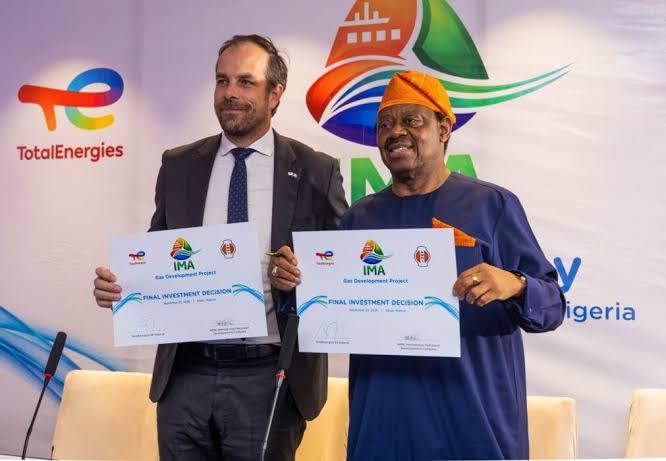
On the recent Nigeria’s oil and gas investment drive, the clearest evidence is the $800 million Final Investment Decision (FID) signed by TotalEnergies and AMNI International for the Ima Gas Field, a project discovered in 1973 that remained undeveloped for more than five decades.
Expected to deliver about 350 million standard cubic feet of gas per day, with first gas targeted for 2028, the project provides a concrete example of how policy, financing, infrastructure and investor confidence must converge before a discovered resource becomes an economic asset.
At the same time, discussions at the Nigeria Energy Leaders Summit 2026 in Lagos exposed the other side of the investment equation. Industry leaders said that funding access, gas infrastructure, equipment availability and credibility remain major constraints to increasing production, even as the federal government targets three million barrels of oil per day by 2030.
DECISION HIGHLIGHT
The Ima FID is more than another upstream investment announcement. It is an example of a previously stranded resource moving through the chain from discovery to financing, development and eventual production.
The project is located in OML 112 and 117, approximately eight kilometres offshore Bonny Island in Rivers State, and is expected to supply feedgas to Nigeria LNG Limited. Its development is therefore connected not only to upstream production, but also to the country’s wider gas-export infrastructure and the additional capacity associated with NLNG Train 7.
DECISION MEMO
The central lesson from Ima is that investment decisions are ultimately made when commercial conditions become sufficiently credible for capital to move.
For more than five decades, the gas field existed as an asset with potential. Its eventual FID required technical, commercial, legal and regulatory conditions to converge.
Mathieu Bouyer, Managing Director of TotalEnergies EP Nigeria, described the decision as a vote of confidence in Nigeria and its oil and gas industry, specifically linking the investment to reforms undertaken by the federal government.
President Bola Ahmed Tinubu similarly framed the project around the government’s efforts to create conditions capable of turning natural resources into productive investments, jobs, industrial activity and exports.
The financing structure adds another dimension. Nigerian financial institutions arranged 77 percent of the project’s financing, while the financial partners include Zenith Bank, Access Bank, United Bank for Africa, Guaranty Trust Bank, Standard Bank, Standard Chartered Bank and First Abu Dhabi Bank.
This is important because one of the industry’s persistent challenges is not simply attracting foreign capital, but building financing structures in which Nigerian institutions can participate meaningfully in large-scale energy projects.
Wole Ogunsanya, Chairman of the Petroleum Technology Association of Nigeria (PETAN) and Chief Executive Officer of Geoplex Drillteq, identified funding as the biggest constraint facing new indigenous producers that acquired assets from international oil companies. He also pointed to equipment shortages affecting swamp and deepwater drilling.
The issue is particularly relevant as indigenous companies assume larger roles following the transfer of assets previously held by international operators. The ability of these companies to finance field development will determine how quickly ownership changes translate into higher production.
Muazu Magaji, Chief Operating Officer of Transoceanic Energy Group, provided another illustration, describing financing a $2.5 billion Floating LNG project as its toughest hurdle.
Obviously, gas increasingly occupies the centre of this investment equation. Ogunsanya identified pipeline infrastructure as a major bottleneck and called for incentives for non-associated gas drilling and stronger mechanisms to ensure gas volumes are developed alongside oil production.
Emeka Onwochei, Technical Director of Navante Oil & Gas, similarly pointed to inadequate gas distribution infrastructure, precision fabrication and servicing capacity as evidence of underinvestment in the sector. He linked some of these deficiencies to power constraints and insufficient long-term demand commitments.
Ima directly addresses part of this infrastructure and supply equation. Its expected 350 million standard cubic feet per day of production will provide feedgas to NLNG, while the project is designed to support the additional capacity associated with Train 7.
The reform questions? The federal government has positioned recent oil and gas reforms as a mechanism for restoring investment confidence.
President Tinubu said that presidential directives issued in 2024 were designed to improve fiscal competitiveness, shorten contracting timelines and reduce project costs.
TotalEnergies’ Bouyer attributed the Ima investment partly to the progress made through these reforms, including measures relating to the non-associated gas sector.
Heineken Lokpobiri, Minister of State for Petroleum Resources (Oil), also described the FID as evidence that the administration’s reforms were restoring investor confidence after years of regulatory and fiscal uncertainty.
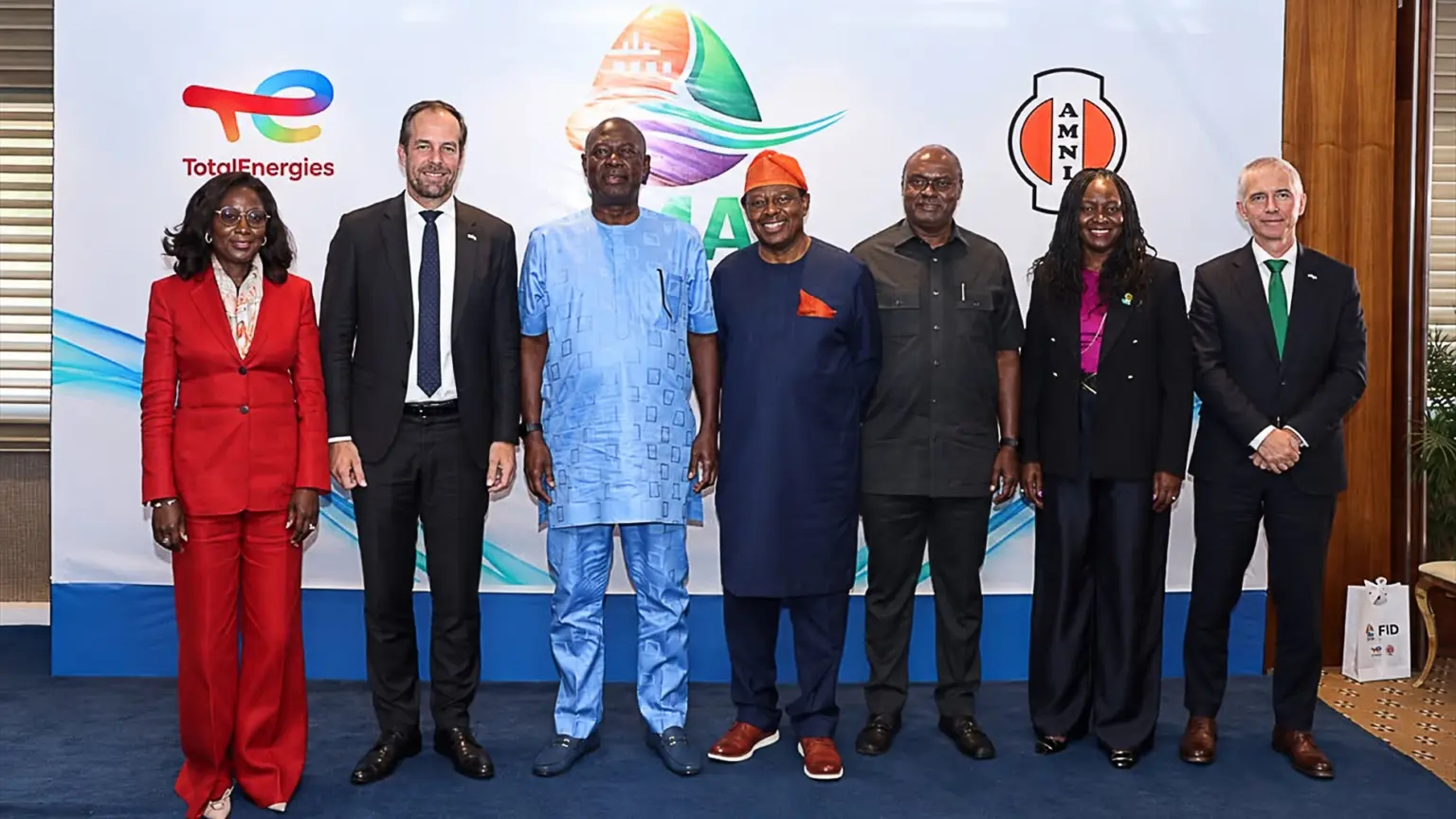
From Left: Olu Verheijen, Special Adviser to the President on Energy; Matthieu Bouyer, MD/Chief Executive of TotalEnergies EP Nigeria; Senator Heineken Lokpobiri, Minister of State for Petroleum Resources (Oil); Dr. Tunde J. Afolabi, Chairman/CEO of AMNI International Petroleum Development Company; Sunny Ewule, Chief of Staff to the Governor of Rivers State; Mrs Oritsemeyiwa Eyesan, Chief Executive of NUPRC, and Oliver Cassassoles, Deputy Managing Director, JV Assets, TotalEnergies EP Nigeria, during the AMNI International Petroleum Development Company & TotalEnergies EP Nigeria IMA FID Ceremony held at Transcorp Hilton, Abuja.
DATA BOX
- Ima Gas Field FID: $800 million
- Expected gas production: 350 million standard cubic feet per day
- Expected first gas: 2028
- Ima discovery: 1973
- Project location: OML 112 and 117, offshore Rivers State
- Project financing arranged by Nigerian financial institutions: 77 percent
- Expected project lifetime value: $2 billion-$4 billion, depending on oil and gas prices
- Federal Government oil production target: 3 million barrels per day by 2030
- Floating LNG project cited at Energy Leaders Summit: $2.5 billion
- Government gas production target: 12 billion cubic feet per day by 2030
WHO WINS / WHO LOSES
The immediate beneficiaries of the Ima development include TotalEnergies, AMNI, participating financial institutions, contractors and host communities.
The Nigerian economy stands to benefit through gas production, export earnings, government revenue, employment and local contracting. The project is also expected to involve Nigerian contractors in its four major project packages.
POLICY SIGNALS
The emerging policy message is that Nigeria’s next energy investment phase requires continuity.
Fiscal competitiveness, regulatory clarity and shorter project timelines must be accompanied by pipelines, drilling equipment, technical services, financing capacity and credible demand.
Josephine Udonsak, Partner at Dentons ACAS-Law, emphasised stronger partnerships among operators, service companies and regulators, alongside government support, as necessary to de-risk projects and unlock funding for gas.
INVESTOR SIGNAL
For investors, the Nigerian energy proposition is becoming increasingly differentiated by execution capacity.
The Ima FID shows that capital can move when commercial, regulatory and technical conditions align. The concerns raised by industry leaders show that substantial gaps remain outside individual projects.
RISK RADAR
The biggest risks remain funding constraints, infrastructure deficits, equipment shortages, regulatory uncertainty and project execution.
There is also a financing challenge for indigenous producers taking over larger assets. Without sufficient capital and technical capacity, asset transfers may not automatically translate into faster production growth.
Enam Obiosio is a public relations and investor relations practitioner and journalist with experience in arts and business journalism, with expertise spanning financial markets, economic policy, infrastructure, corporate communications, and the creative economy.
Discover more from StakeBridge Media
Subscribe to get the latest posts sent to your email.