

By Olumide Johnson
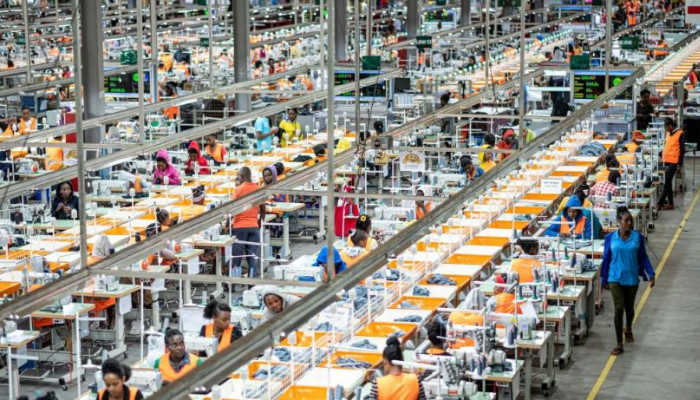
The Nigerian Economic Summit Group (NESG) has warned that Nigeria’s manufacturing sector is suffering a structural decline as high energy costs, import competition, inadequate financing and weak industrial coordination continue to undermine productive capacity. The warning comes ahead of the 32nd Nigerian Economic Summit, which will focus on jobs, productivity and shared prosperity.
DEVELOPMENT:
The NESG said that manufacturing, which should anchor Nigeria’s structural transformation, is instead contributing a declining share of gross domestic product (GDP) while failing to develop the backward and forward linkages associated with industrialisation.
It said, “In manufacturing, the sector contributes a declining share of GDP and has failed to develop the deep backward and forward linkages that characterise industrialising economies.”
The group said that Nigeria continues to export raw materials and import finished products despite its natural resources and domestic market of more than 220 million consumers.
It identified energy costs, import competition, inadequate infrastructure, inefficient regulation and weak institutional capacity as major constraints. “Energy costs remain crippling, with manufacturers frequently citing electricity as their single largest operational constraint. Import competition, particularly from subsidised goods, has undermined domestic producers.”
DATA:
The NESG said capital has historically gravitated towards financial services, real estate and trading, while manufacturing plants, agro-processing and industrial infrastructure requiring long-term financing remain underfunded.
Agriculture, which employs about 36 percent of Nigeria’s labour force, also suffers post-harvest losses estimated at 30 to 40 percent for many food commodities.
SIGNIFICANCE:
The industrial weakness has consequences beyond factory output. It limits job creation, suppresses domestic value addition, sustains import dependence and exposes economic growth to commodity price cycles.
The NESG described the misallocation of capital as “both a market failure and a policy failure,” arguing that it helps explain Nigeria’s productivity stagnation.
The warning is particularly significant for investors because persistent energy and financing constraints raise operating costs, weaken competitiveness and discourage the long-term capital required for industrial expansion.
NEXT MOVE:
The October 26-27 summit will examine Special Economic Zones, fiscal incentives, local-content frameworks, development finance, blended finance and risk-sharing mechanisms for productive-sector lending.
The “Produce Nigeria” dialogue will bring manufacturers, agro-industrialists, investors, policymakers and innovators together around the transition from primary production to higher-value industrial output.
OUR LENS:
Nigeria’s industrial problem is no longer adequately explained by insufficient production capacity alone. The deeper failure is the absence of an ecosystem that makes production more attractive than trading, extraction or short-term financial investment.
The NESG’s intervention points to a fundamental policy choice: Nigeria can continue exporting raw materials and importing finished products, or deliberately redirect capital, infrastructure and incentives towards production.
Until that choice is made decisively, the country’s enormous market will remain more valuable as a destination for imported goods than as the foundation for an industrial economy.
Olumide Johnson is a journalist, reporting on energy, business, markets, policy and developments shaping Nigeria’s economy.
Discover more from StakeBridge Media
Subscribe to get the latest posts sent to your email.