

By Jennete Ugo Anya
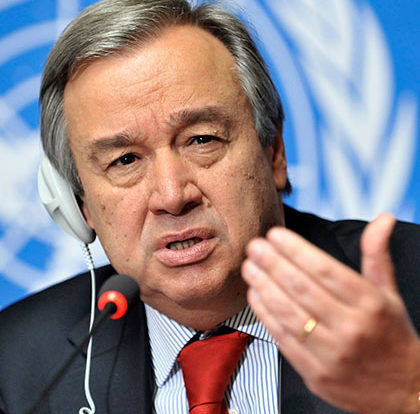
The Secretary-General of United Nations (UN), Mr. António Guterres, has used the Brazil, Russia, India, China, South Africa (BRICS) summit in New Delhi to demand a restructuring of the post-World War II global order, arguing that institutions such as the UN Security Council and Bretton Woods system no longer reflect the distribution of economic, demographic and geopolitical power.
DEVELOPMENT:
Addressing leaders of BRICS and other participating countries, Guterres said that the world was moving towards multipolarity and that the institutional architecture of global governance must adapt.
“Today’s economic, demographic and geopolitical realities are not those of 1945,” Guterres said. “Our institutional structures must reflect it.”
He added that the countries represented at the summit “speak to that changing reality” and that “we are increasingly moving towards a multipolar world.”
Guterres argued that multipolarity could produce greater balance only if accompanied by reform of the Security Council and Bretton Woods institutions. He also called for four priorities: financing, technology, climate justice and peace.
DATA:
Guterres said developing countries need “massive international support” to achieve the Sustainable Development Goals (SDGs) and urged multilateral development banks to become “bigger, better and bolder.”
On climate finance, he pressed wealthy nations to honour existing commitments, including $300 billion annually, alongside increased adaptation finance and loss-and-damage funding.
SIGNIFICANCE:
The intervention goes beyond diplomatic rhetoric. It reflects a widening contest over who sets the rules governing international finance, security, technology and access to strategic resources.
Guterres warned that artificial intelligence is increasingly controlled by a narrow group. “Its power sits with a few companies, in a few countries,” he said, warning that “the AI divide will widen every other divide” unless unchecked.
His position gives emerging economies a stronger institutional argument for demanding greater representation in global decision-making.
NEXT MOVE:
The test will be whether BRICS members can translate calls for reform into a coordinated negotiating position on Security Council representation, development finance, AI governance, climate funding and critical minerals.
Guterres also pointed to Gaza, the wider Middle East, Ukraine and Sudan, urging states to uphold the UN Charter, including “sovereign equality,” territorial integrity and “peaceful settlement of disputes.”
OUR LENS:
The deeper signal is that the global order is no longer merely experiencing a power transition. Its institutional legitimacy is increasingly being challenged by the countries whose economic and geopolitical weight has grown since 1945.
Guterres captured the dilemma when he said: “As we move irreversibly to a multipolar world, all countries must work to strengthen and safeguard a multilateral system that delivers for all with the United Nations at its centre.”
Jennete Ugo Anya is a journalist and researcher with interests across Nigeria’s economy, public policy, business, development and strategic communications.
Discover more from StakeBridge Media
Subscribe to get the latest posts sent to your email.