

By Enam Obiosio
The Nigerian Ports Authority (NPA) has joined a widening circle of institutions and leaders mourning the death of Alhaji Bamanga Tukur, an elder statesman, businessman and international economic figure whose long public life was woven into some of the defining chapters of Nigeria’s political and commercial history.
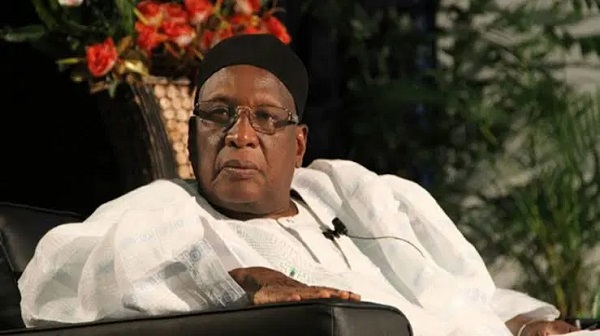
Tukur died on Saturday, September 12, 2026, at his residence in Abuja, aged 90. But for the Nigerian ports community, his passing carries a particular resonance. Long before he became governor, minister, political party chairman or one of Africa’s prominent private-sector voices, Tukur stood at the helm of the institution through which Nigeria’s commerce met the world.
He was General Manager and Chief Executive of the NPA from 1975 to 1982, a seven-year stewardship that placed him at the centre of Nigeria’s maritime and trade architecture during a formative period in the nation’s economic history.
It was therefore fitting that Dr. Abubakar Dantsoho, the NPA’s Managing Director and Chief Executive Officer, joined Adamawa State Governor Ahmadu Fintiri to receive the remains of the departed statesman. In doing so, the present leadership of Nigeria’s ports institution paid homage not merely to a former chief executive, but to a predecessor whose career became inseparable from the broader story of Nigerian enterprise and trade facilitation.
In a statement signed by the NPA’s General Manager, Corporate Affairs, Mr. Ikechukwu Onyemekara, Dantsoho expressed the institution’s grief and described Tukur as a figure whose influence reached well beyond the confines of public office.
“I will like to, on behalf of the entire Management and Staff of the NPA, express our profound condolences and deepest sympathies to his immediate family, the Federal Republic of Nigeria and indeed the good people of Adamawa State on the demise of a pillar of trade facilitation and an inspiration to many,” Dantsoho said.
The words carry particular weight because the ports are more than physical gateways. They are the places where a nation’s economic aspirations acquire movement, where ships arrive bearing the machinery of production and depart carrying the products of enterprise, and where the efficiency of trade can either accelerate or impede national prosperity.
Tukur’s years at the NPA belonged to an era when Nigeria was still shaping the institutional foundations of its modern commercial economy. His stewardship of the Authority placed him within that important generation of administrators who understood that ports were not merely harbours for vessels, but strategic instruments of national development.
For the NPA, his passing is therefore not simply the departure of a former chief executive. It is the closing of a long chapter in the memory of an institution that has watched Nigeria’s commercial ambitions evolve across generations.
And as the ships continue to arrive, the cargoes move and the nation’s gateways remain open to the world, the name Bamanga Tukur will remain etched into the institutional history of the NPA, a reminder of a man who once stood at the helm of Nigeria’s maritime gateway and later spent a lifetime arguing, in different arenas, for the possibilities of Nigerian and African enterprise.
From the NPA, Tukur’s public journey expanded into politics, governance and industry. He became governor of the old Gongola State in 1983, although his tenure, which began in October, was abruptly terminated by the military coup that ended the Second Republic in December of that year.
He later returned to the national stage as Minister of Industries under the military administration of General Sani Abacha between 1993 and 1995. Yet public office was only one dimension of a life that continually moved between government and enterprise.
After leaving office, Tukur established BHI Holdings, also known as the DADDO Group of Companies, and emerged as a prominent figure in Nigerian business. His influence subsequently assumed a continental dimension. As Executive President of the African Business Roundtable and Chairman of the NEPAD Business Group, he advocated African economic development, private-sector expansion and greater economic cooperation across the continent.
In that sense, the arc of his career was remarkably consistent. Whether at the ports, in government, in industry or within continental business organisations, Tukur repeatedly occupied spaces where the state, commerce and development converged.
President Bola Ahmed Tinubu, in mourning the former governor, described his death as the end of a remarkable chapter in Nigeria’s political and economic history.
Through his Special Adviser on Information and Strategy, Mr. Bayo Onanuga, the President described Tukur as a towering figure whose career traversed public administration, governance, business, politics and pan-African economic leadership.
“Alhaji Tukur was urbane, generous and deeply rooted in the values of integrity and service that the Adamawa Emirate and the nation hold dear. He was a man of big ideas and bold enterprise who believed in Nigeria’s limitless potential. Nigeria will sorely miss his wise counsel and fatherly guidance,” Tinubu said.
In Adamawa, the grief is equally profound. Governor Fintiri has described Tukur’s death as a “monumental loss”, recalling the breadth of his contribution to the state and the country.
“Alhaji Bamanga Tukur was a colossus who made remarkable contributions to the development of Adamawa State and Nigeria. His wealth of experience, wisdom and commitment to public service earned him a place of honour in our national history,” Fintiri said.
He stated that he would personally miss Tukur’s wise counsel and the depth of experience he brought to matters concerning the state and the nation. Fintiri subsequently declared three days of mourning across Adamawa State and directed that government flags be flown at half-mast.
Tukur’s political chapter also included his emergence as National Chairman of the Peoples Democratic Party (PDP) in 2012. He resigned in January 2014 after leading the party through a period of intense political tensions. The PDP, in its tribute, remembered him as a distinguished statesman, administrator, businessman and committed party member whose institutional knowledge and decades of public service shaped his contribution to democratic development.
But beneath the titles lies the more enduring thread of Tukur’s life: service across institutions.
He was Tafidan Adamawa, a recipient of the national honour of Commander of the Order of the Niger (CON), and a figure whose influence extended from the corridors of Nigeria’s ports to the wider chambers of African economic advocacy.
His remains are being taken to Yola, where funeral prayers are scheduled for 10:00am on Sunday, September 13, at the Lamido’s Palace, before his burial in accordance with Islamic rites.
At 90, Bamanga Tukur leaves behind children and grandchildren, but also something less easily buried: an institutional legacy scattered across Nigeria’s ports, public administration, politics, industry and the continental enterprise of African development.
Enam Obiosio is a public relations and investor relations practitioner and journalist with experience in arts and business journalism, with expertise spanning financial markets, economic policy, infrastructure, corporate communications, and the creative economy.
Discover more from StakeBridge Media
Subscribe to get the latest posts sent to your email.