

By Hannah Yemisi
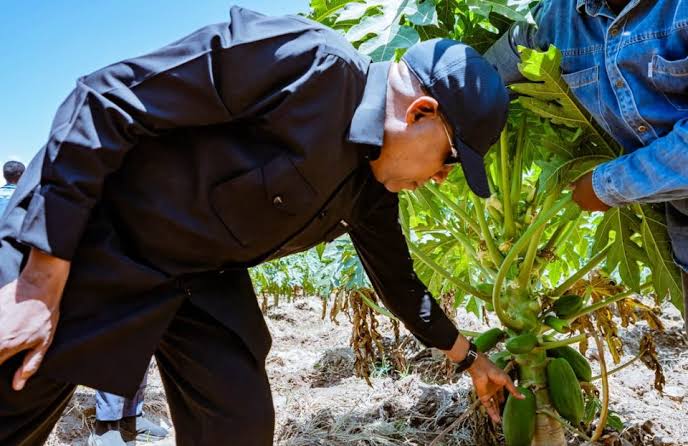
Vice-President Kashim Shettima, leading Nigeria’s delegation to the Ethiopia–Nigeria Leadership Exchange, visited farms and agricultural facilities in Ethiopia’s Oromia region on 8 October 2026, advocating the adoption of Ethiopia’s mechanised, export-oriented agricultural model. He identified improved seeds, climate-smart agriculture and modern farming as priorities for Nigeria, announced plans to plant 20 billion trees from the next rainy season, and called for closer Nigerian-Ethiopian cooperation to strengthen African food security. Oromia Regional State President, Shimelis Abdisa, outlined Ethiopia’s crop diversity, wheat exports and agricultural partnerships, including fertiliser production with the Dangote conglomerate.
DECISION HIGHLIGHT
Nigeria is looking to translate agricultural potential into food sovereignty, export earnings and rural employment by combining modern production with infrastructure, environmental restoration and regional cooperation. The economic challenge is converting the proposed initiatives into measurable productivity gains and commercially viable supply chains.
DECISION MEMO
The economic importance of Ethiopia’s Oromia model lies in the relationship between agricultural production, processing, input supply and export markets. For Nigeria, replicating selected elements could reduce food import dependence, improve farm productivity and create opportunities across fertiliser, mechanisation, storage, processing and transport.
In a release by Mr. Stanley Nkwocha, Senior Special Assistant To The President on Media & Communications, (Office of The Vice President), Shettima said: “We intend to embrace improved seeds, mechanization, and climate-smart agriculture.”
He warned: “Food dependency compromises our sovereignty. Without independence in food production, a nation remains incomplete in its sovereignty.”
Ethiopia’s reported transition from importing about US$1 billion in wheat annually to self-sufficiency and exports to neighbouring countries illustrates the potential value of domestic production at scale. Shettima described Ethiopia as “the pathfinder, the front runner in us reclaiming our pride and our continent”, adding: “Africa must learn to feed itself. Ethiopia is doing it and Nigeria is on course to do the same. Ethiopia is a success story worthy of emulation.”
Shettima also stated: “With a population of 100 million people, and a combined population with Nigeria of over 400 million, Ethiopia’s success will reverberate across the length and breadth of East and Southern Africa.” The broader opportunity is regional: stronger production in two large markets could support food trade and agricultural investment, provided infrastructure and trade arrangements allow surpluses to move efficiently.
Shettima’s proposed 20-billion-tree campaign, drawing lessons from Ethiopia’s Green Legacy Initiative, adds an environmental dimension. He said: “We will embark on a massive tree-planting campaign in the next rainy season. It requires a lot of planning, energy and drive, which Ethiopia was able to galvanize its population into doing. We intend to plant 20 billion trees.”
However, the model’s transferability depends on Nigeria’s implementation capacity, financing, farm-level infrastructure, input availability and market access. Mechanisation and improved seeds can raise output, but without storage, reliable transport, processing capacity and predictable market arrangements, higher production may not translate into better farm incomes or lower consumer prices.
Abdisa said that more than 200 crop varieties were cultivated across Ethiopia, with exports including bananas, avocados and coffee. He put annual revenue from wheat production at more than US$3.1 billion and cited expanding poultry production. The region’s collaboration with the Dangote conglomerate on fertiliser production also illustrates how agricultural development can connect industrial investment with farm productivity.
The initiative could support restoration and livelihoods, but its impact would depend on land suitability, survival rates, maintenance and transparent monitoring. Tree-planting totals alone would not demonstrate ecological or economic success.
DATA BOX
- Tree-planting target: 20 billion trees, beginning next rainy season.
- Ethiopian crop diversity: More than 200 varieties, according to Abdisa.
- Wheat: Reported annual production revenue exceeding US$3.1 billion.
- Historical wheat imports: About US$1 billion annually before Ethiopia achieved reported self-sufficiency.
- Nigeria’s agricultural priorities: Improved seeds, mechanisation and climate-smart farming.
- Private-sector link: Dangote conglomerate collaboration on fertiliser production in Oromia.
WHO WINS / WHO LOSES
Potential winners: Farmers, fertiliser producers, equipment suppliers, food processors, logistics operators and exporters if productivity and market access improve.
Potential losers: Food importers could face reduced demand if local production becomes competitive. Farmers may lose out if investment favours large-scale operators without improving smallholder access to inputs and markets.
POLICY SIGNALS
The exchange points to agricultural modernisation, environmental restoration and bilateral cooperation. Delivery requires funded programmes, clear institutional responsibilities, farmer inclusion and measurable targets beyond headline production and tree-planting figures.
INVESTOR SIGNAL
Fertiliser, mechanisation, irrigation, storage, agro-processing and agricultural logistics could attract investment if government commitments translate into bankable projects, reliable supply chains and predictable returns.
RISK RADAR
Key risks include funding gaps, climate shocks, weak rural infrastructure, poor maintenance of planted trees and uneven access to technology. Ethiopia’s experience offers lessons, not a ready-made formula; Nigeria’s results will depend on adapting the model to local production systems and execution capacity.
Hannah Yemisi is a reporter of note, governance, state government, healthcare, sustainability, agriculture, reporting on education, and social developments with a focus on accuracy, context and public relevance.
Discover more from StakeBridge Media
Subscribe to get the latest posts sent to your email.