

By Enam Obiosio
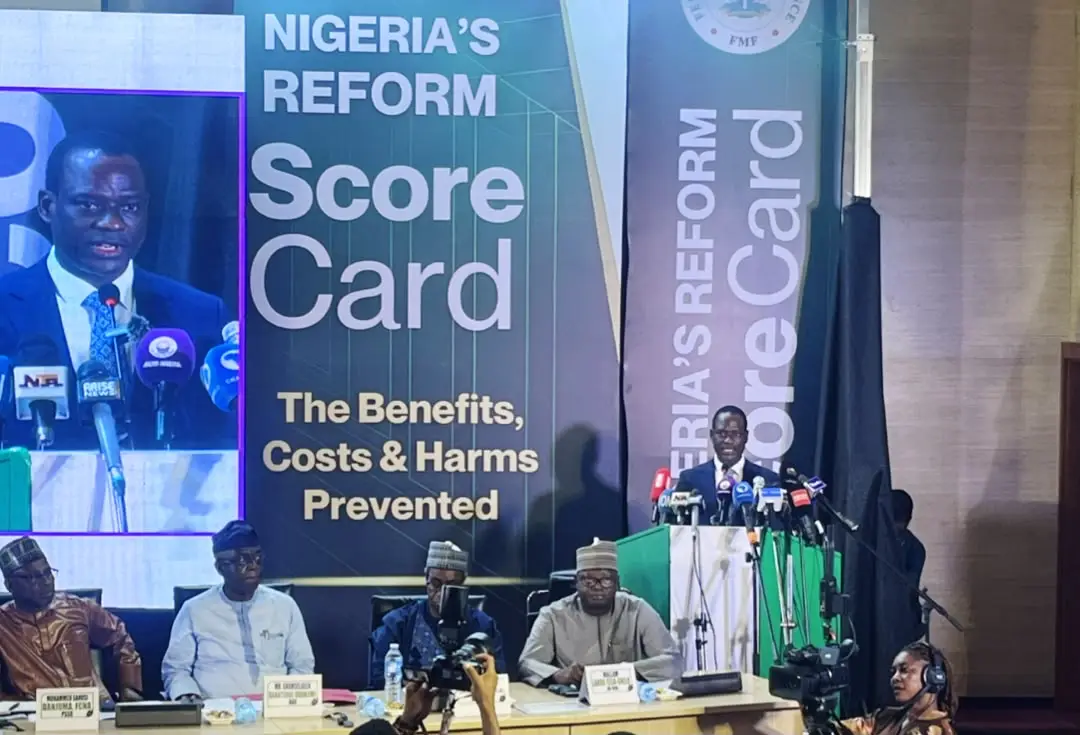
I have never believed economic reform should be judged by how beautifully government presents it. I judge reform by what it does to the state’s capacity to survive, the economy’s ability to recover and the ordinary citizen’s prospect of having a better tomorrow. That is why the Federal Ministry of Finance’s latest presentation, ‘Nigeria’s Reform ScoreCard: The Benefits, Costs and Harms Prevented’, deserves to be read carefully, not merely applauded or dismissed. Its most important argument, in my view, is not simply what the reforms have achieved, but what they may have prevented.
We can argue endlessly about whether Nigerians are better off today than they were before the reforms. Many households will understandably say that their daily reality remains brutally difficult. But we should also ask a more uncomfortable question: where would Nigeria have been if the old fiscal and monetary arrangements had continued unchanged? The Finance Ministry’s counterfactual is stark. It says debt service relative to revenue, which was around 100 percent in 2022, is projected at about 50 percent in 2026. Without reform, it estimates that the ratio could have remained between 100 and 200 percent. It says 27 states that were unable to pay salaries in 2023 could have become at least 30 states facing bankruptcy under the no-reform scenario, while the legacy Ways and Means financing stock of about N30 trillion could have exceeded N60 trillion without intervention.
We should not dismiss these numbers simply because the reforms have imposed painful costs. But neither should we use them to tell Nigerians that their suffering is imaginary. It is not. The presentation itself acknowledges that inflation remains high, household welfare is still under pressure and fuel-price adjustment has imposed a major cost. Headline inflation stood at 15.91 percent in June 2026, compared with 22.41 percent in May 2023, while food inflation was 17.52 percent against 24.82 percent at the starting point. Yet petrol prices moved from roughly N185 per litre to between N1,100 and N1,400. The document describes poverty and household welfare as a work in progress and the real effect of the minimum-wage increase as mixed.
This is where I think we must be intellectually honest. A fall in inflation does not mean prices have fallen; it means prices are rising more slowly. A stronger foreign-reserve position does not automatically put more food on a family’s table. A better sovereign yield does not immediately pay a worker’s transport bill. A healthier fiscal position does not, by itself, repair a household’s purchasing power. So, yes, we must challenge government to convert macroeconomic stabilisation into household welfare. But we should not make the opposite mistake of pretending that macroeconomic stability has no value. It has enormous value.
The external-sector numbers in the presentation are difficult to ignore. Gross foreign exchange reserves are put at US$52.5 billion in July 2026, against about US$35 billion in May 2023. Net reserves are reported at US$34.8 billion at the end of 2025, compared with about US$3 billion in 2023. The official-parallel market premium has fallen from more than 60 percent to below five percent, while the current account moved from a US$1.21 billion surplus in 2023 to a US$14.04 billion surplus in 2025. For me, this is not an argument for triumphalism. It is an argument for recognising that Nigeria’s external position has materially changed.
We cannot simultaneously complain that the naira was previously distorted by multiple exchange rates, scarce foreign exchange and opaque allocation mechanisms, and then complain that correcting those distortions produced painful adjustment. There was never going to be a painless route out of a system that had become increasingly expensive to sustain. The question is whether the pain produces a stronger economic foundation or merely shifts the burden from one part of the economy to another.
The investment numbers are equally important. The presentation puts total capital importation at US$10.37 billion in the first quarter of 2026, against US$1.13 billion in the first quarter of 2023. Foreign direct investment rose from US$895 million in 2022 to US$4.01 billion in 2025. Stock-market capitalisation increased from approximately N31 trillion in May 2023 to about N150 trillion by June 2026. Sovereign Eurobond yields are reported at about seven to eight percent in mid-2026, compared with roughly 10 to 13 percent previously. These are not trivial movements. They tell us that investors are beginning to price Nigeria differently.
But here again, we must resist the temptation to declare victory. An economy does not become prosperous because its stock market rises. It becomes prosperous when investment translates into productive capacity, jobs, income, exports and better living standards. That is why I believe the growth figures are more important than the financial-market statistics. Real GDP growth is reported at 3.89 percent in the first quarter of 2026, against 2.31 percent in the first quarter of 2023. Non-oil GDP growth is projected at about four percent in 2026, manufacturing growth reached 3.29 percent in the first quarter, while oil production has recovered to between 1.6 and 1.75 million barrels per day from roughly 1.2 to 1.4 million previously.
That is the beginning of recovery, not the destination. And this is where I believe the government must now change the emphasis. The first phase of reform was about stopping deterioration. The next phase must be about making growth felt. We cannot continue to tell Nigerians that the economy would have been worse without reform. At some point, Nigerians are entitled to ask whether the economy is becoming better because of reform. That is a much higher standard.
The Finance Ministry’s own presentation appears to recognise this. Its forward agenda includes translating macroeconomic gains into meaningful household impact, continuing tax reform, improving budgeting and accountability, bringing inflation towards single digits, maintaining a predictable exchange rate, reducing poverty, strengthening agriculture and improving the quality and priority of public spending. I agree with that direction. We should stay the course, but staying the course must not mean refusing to adjust course when evidence demands it.
We need reforms that preserve fiscal discipline without strangling productive businesses. We need monetary stability without permanently pricing smaller businesses out of credit. We need foreign-exchange stability that encourages investment without sacrificing productive imports. We need infrastructure spending that raises productivity rather than simply increasing expenditure. Above all, we need to move from reform accounting to reform delivery.
The presentation says incremental resources of N20.4 trillion were generated through N5.4 trillion in subsidy savings, N3.1 trillion in other incremental revenue and N11.9 trillion in borrowing. Yet incremental expenses reached N30.64 trillion, including N9.39 trillion in wage adjustments, N9.37 trillion in external debt-service effects and N6.47 trillion in strategic infrastructure. That tells me something important: subsidy removal did not magically create a government swimming in cash. We still had to borrow. We still had to spend. We still had to absorb the consequences of exchange-rate movements and higher debt-service costs.
This is why the simplistic narrative that subsidy removal created an enormous cash windfall for the federal government is misleading. The reform created fiscal space and redistributed resources through the Federation Account, but the expenditure demands facing government were much larger. The real test now is whether we use that breathing space intelligently.
I therefore support reform, but I do not support complacency. We should defend the gains, acknowledge the costs and insist on the unfinished work. We should celebrate reserves without forgetting food prices. We should welcome investment without forgetting jobs. We should recognise fiscal stabilisation without forgetting poverty. We should acknowledge stronger growth without accepting mediocre growth as Nigeria’s permanent destiny.
Discover more from StakeBridge Media
Subscribe to get the latest posts sent to your email.