

By Ayo Susan
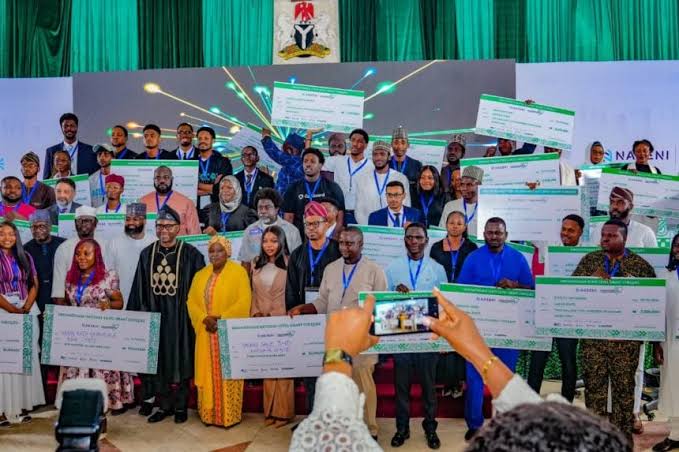
The National Agency for Science and Engineering Infrastructure (NASENI) has awarded N435.5 million to innovators nationwide under its maiden Innovate Naija, Future Makers, intra-agency and inter-agency competitions. The awards were presented at the State House Banquet Hall, Presidential Villa, Abuja, with President Bola Tinubu represented by the Minister of Innovation, Science and Technology, Dr Kingsley Udeh. The initiative seeks to develop local technological solutions, commercial ventures and industrial capacity. NASENI Executive Vice Chairman and Chief Executive Officer, Khalil Halilu, urged beneficiaries to protect their intellectual property, strengthen their businesses and develop solutions to practical Nigerian challenges.
DECISION HIGHLIGHT
NASENI is using competitive grants to identify innovators and support the transition from ideas to commercially viable products, but long-term impact will depend on execution and market adoption.
DECISION MEMO
The N435.5 million allocation creates an initial funding pathway for Nigerian innovators, distributing resources across national, state, youth-focused and institutional competitions. The strategic test, however, is whether the awards produce sustainable businesses and technologies that reduce dependence on imported solutions.
President Tinubu reaffirmed the federal government’s commitment to home-grown innovation and industrialisation. He urged recipients to deploy the grants responsibly, refine their products, test assumptions and build sustainable businesses.
Halilu emphasised the commercial disciplines required to turn innovation into enterprise, advising recipients to understand their finances, protect intellectual property, build capable teams and pursue strategic partnerships. His message recognises that funding alone cannot guarantee commercial viability.
Nanko Madu, Director of Programmes at AfriLabs, commended NASENI and the Federal Government for recognising innovation as a driver of development. She noted that young Nigerians were developing solutions adapted to local infrastructure, power constraints, climate and operating conditions, potentially reducing reliance on imported technologies and foreign expertise.
The competitions therefore represent an early-stage intervention in Nigeria’s technology pipeline. Their value will ultimately be measured not by grants disbursed but by products deployed, businesses sustained, jobs created and practical problems solved. The announcement provides no outcome targets or monitoring framework against which those results can yet be assessed.
DATA BOX
- Total grants: N435.5 million.
- Innovate Naija: N100 million for the national winner; N30 million and N20 million for the runners-up.
- State champions: 37 winners received N2.5 million each.
- Inter-agency competition: N140 million shared among three winners.
- Intra-agency competition: N22.5 million shared among three winners.
- Future Makers: N23 million shared among six finalists; the overall winner received N5 million.
- Primary objective: Develop home-grown technology, commercial ventures and industrial capacity.
WHO WINS / WHO LOSES
Winners: Grant recipients, emerging technology businesses and potential users of locally developed solutions.
Potential losers: Innovators whose projects fail to secure follow-on funding or achieve market adoption may struggle to sustain development beyond the grant period.
POLICY SIGNALS
The initiative signals public support for domestic innovation. Transparent selection, milestone-based monitoring and measurable commercial outcomes would strengthen accountability.
INVESTOR SIGNAL
The competitions could expose investors and industry partners to locally developed technologies. Follow-on investment will depend on product validation, intellectual property protection, capable teams and credible routes to market.
RISK RADAR
Key risks include weak commercialisation, inadequate follow-on capital, limited infrastructure, poor intellectual property protection and insufficient monitoring. Without evidence of post-award performance, the grants’ contribution to industrial development remains unproven.
Ayo Susan is a journalist, covering business, infrastructure, insurance, technology, society and emerging developments with an emphasis on credible and engaging storytelling.
Discover more from StakeBridge Media
Subscribe to get the latest posts sent to your email.