

- How NEC Is Turning Economic Reform from Policy Intent into State-Level Delivery on Jobs, Security, Industrial Growth and Everyday Welfare Outcomes
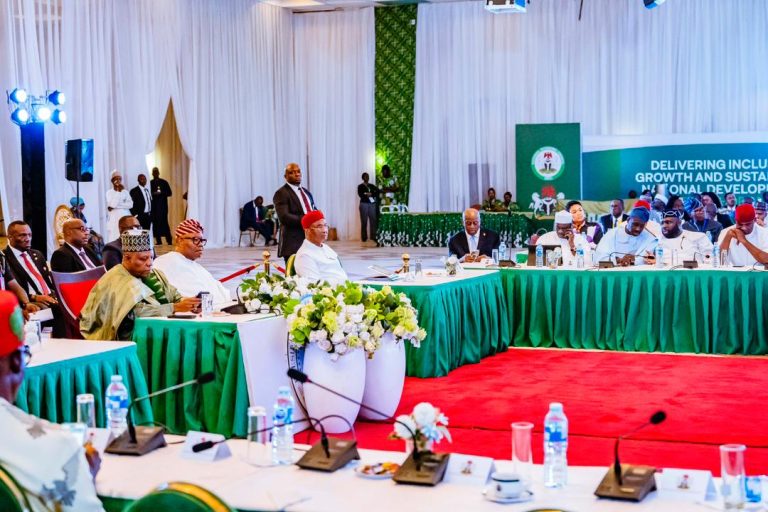
The National Economic Council (NEC) conference in Abuja marked a quiet but decisive change in tone. Economic change was no longer framed as something to be explained or defended, but as something that must be felt. Leaders at both federal and state levels aligned around a simple test: do these choices improve how people live and work? That question now anchors discussions on revenue, security, production and social spending. Responsibility is also being redistributed. While the centre provides stability and direction, governors are expected to turn policy into visible progress within their local economies. The message was clear. Progress will now be judged by outcomes on the ground, not by the elegance of policy design. Enam Obiosio writes …
At the recent National Economic Council (NEC) conference, federal and state authorities collectively repositioned economic reform as a delivery obligation tied to citizen welfare. The presidency directed that macroeconomic measures must translate into employment, infrastructure and welfare gains, while states were tasked with tax harmonisation, human capital spending, domestic production expansion and non-kinetic security responses anchored on poverty reduction.
DECISION HIGHLIGHT
Policy Direction
Shift from reform announcements to visible economic impact.
Fiscal Governance
Nationwide harmonised tax framework and coordinated fiscal federalism.
Security Framework
Economic inclusion as part of internal security architecture.
Industrial Strategy
Domestic refining, value-chain expansion and import substitution.
Growth Model
Bankable projects across agriculture, manufacturing, logistics, energy and digital infrastructure.
Human Capital
Higher per capita spending on education, health and youth employment.
Investment Climate
Stronger public-private-subnational partnerships and concessional financing.
DECISION MEMO
The conference converted reform from a credibility narrative into a performance contract. President Bola Tinubu’s position, delivered by Senate President Godswill Akpabio, was explicit that macroeconomic policy will now be judged by tangible welfare outcomes rather than fiscal metrics alone.
He stated, “The decisions we make here must translate into visible improvements in the daily lives of all Nigerians, in jobs created, businesses supported, roads constructed, schools strengthened, healthcare improved and opportunities expanded.”
He further emphasised that policy continuity is essential, saying, “Reform is not an event. It is a process. It requires courage, patience and consistency.”
And he added a political accountability benchmark, “The renewed hope agenda is not a slogan. It is a national commitment, and that commitment demands that we move beyond dialogue to delivery.”
The implication is structural. Reform success is no longer measured at the federal treasury but at the subnational economy. The centre stabilises the macro framework, states must now transmit growth.
The tax harmonisation directive reveals the economic logic. Nigeria’s fragmented internal market imposes transaction costs that suppress productivity. Aligning state tax regimes effectively builds a domestic common market, lowering operational friction for businesses and improving capital efficiency.
Security policy was also reframed. The council linked insecurity to labour market failure, not just policing capacity, recommending non-kinetic interventions targeting unemployment and poverty. This embeds economic policy inside the national security strategy.
On energy, the directive to expand domestic refining signals a shift from revenue extraction to industrial ecosystem development, reducing foreign exchange leakages and strengthening value chains.
State governors reinforced the investment narrative. Ogun State Governor, Dapo Abiodun, said: “There’s stability in the forex market. There’s confidence in holding the naira. Macroeconomic policies are the biggest enabler of investor confidence.”
Lagos State Governor, Babajide Sanwo-Olu, emphasised implementation risk, noting that citizens only benefit when resolutions are executed beyond government circles.
Collectively, the statements show the reform phase is shifting from stabilisation to transmission. The central government provides policy credibility, states now carry execution credibility.
Subscribe to Stakebridge Media for exclusive insights on Nigeria’s state-level reform execution, investment-ready projects, and industrial growth opportunities.
DATA BOX
Conference duration: 2 days
Delegates: over 300
States with harmonised tax law passed: 12
States with pending tax bills: 13
States yet to commence: 11
Policy horizon: National Development Plan 2026-2030
WHO WINS / WHO LOSES
Winners
Domestic manufacturers, infrastructure developers, logistics operators, formal sector SMEs, institutional investors.
Losers
Import arbitrage traders, fragmented local tax collectors, informal levies ecosystem, pure trading intermediaries.
POLICY SIGNALS
Macroeconomic reform entering delivery phase.
Security policy merging with economic inclusion.
Energy strategy shifting toward industrialisation.
Federalism evolving toward coordinated taxation.
INVESTOR SIGNAL
Macro stability becoming baseline assumption.
Return potential tied to state-level execution quality.
Production and infrastructure sectors move to centre of opportunity set.
RISK RADAR
Uneven state implementation capacity.
Resistance to tax harmonisation.
Lag between policy adoption and welfare impact.
Infrastructure bottlenecks limiting domestic production gains.
Discover more from StakeBridge Media
Subscribe to get the latest posts sent to your email.