

By Olumide Johnson
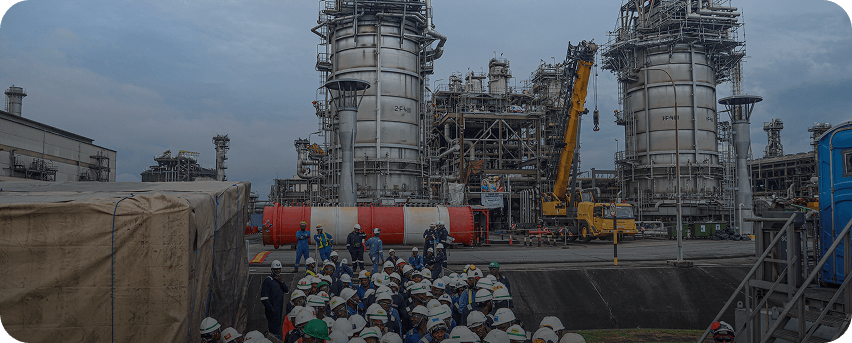
Nigeria Liquefied Natural Gas (NLNG) has announced that its $5 billion Train 7 project has reached 92 percent completion and is advancing into systems completion and pre-commissioning, marking a major milestone in Nigeria’s gas expansion and industrial capacity drive. The update was recently delivered in Lagos at the 2026 Nigerian Oil and Gas Midstream and Downstream Summit organised by the Nigerian Content Development and Monitoring Board (NCDMB).
Project Director of NLNG Train 7, Ali Uwais, representing Managing Director of NLNG, Adeleye Falade, stated that the project moved from prolonged uncertainty into execution following front-end engineering redesigns, a Final Investment Decision (FID) in 2019 by shareholders including Nigerian National Petroleum Company Limited (NNPC), Shell, TotalEnergies and Eni, and engineering contract awards during the COVID-19 period.
Uwais said that Train 7 would raise NLNG’s production capacity from 22 million tonnes per annum (MTPA) to 30MTPA while simultaneously accelerating indigenous industrial participation across fabrication, cable manufacturing and engineering services.
“One of the most important decisions we made earlier in the project was to treat Nigerian content not as a compliance obligation, but as a development opportunity,” Uwais stated.
Meanwhile, NCDMB disclosed that operating companies in Nigeria’s upstream oil and gas sector had increased from fewer than 10 before the Nigerian Oil and Gas Industry Content Development (NOGICD) Act 2010 to 117 currently, while service companies expanded to 11,764.
DECISION HIGHLIGHT
The Train 7 project is increasingly emerging as both an energy infrastructure expansion and an industrial policy instrument. Beyond export capacity growth, the project reflects a deliberate attempt to institutionalise domestic manufacturing, fabrication and technical competence within Nigeria’s oil and gas value chain.
Uwais said that Nigerian firms including Dorman Long, Aveon and African Industries supplied substantial portions of structural steel requirements, while companies such as Coleman, Mecom, Medgene and Cable Metal manufactured medium and high-voltage cables locally.
Executive Secretary of NCDMB, Felix Ogbe, represented by Austin Azuka, stated that Nigeria was increasingly transitioning “beyond being merely a producer of crude oil to becoming a processor and exporter of finished and semi-finished energy products.”
DECISION MEMO
The broader significance of Train 7 lies less in liquefied natural gas volumes and more in whether Nigeria can convert isolated mega-project execution into sustained industrial capability.
For over a decade, local content policy largely focused on participation ratios and procurement metrics. Train 7 appears to represent a more substantive shift towards capability accumulation, where Nigerian firms are not merely subcontractors but increasingly embedded within manufacturing, fabrication and technical delivery chains.
The project also demonstrates how gas infrastructure is gradually replacing crude oil expansion as the centrepiece of Nigeria’s energy industrialisation strategy. The increasing policy emphasis on gas processing, petrochemicals, refining and compressed natural gas distribution reflects an attempt to deepen domestic value retention rather than sustain raw hydrocarbon export dependence.
However, Uwais’ warning about post-project decline exposes the structural vulnerability within Nigeria’s industrial ecosystem. Without continuous large-scale investments, fabrication yards, technical labour pools and local manufacturing networks built around Train 7 could deteriorate after project completion.
“The real value of Train 7 will be measured by what Nigeria does with the experience, skills, infrastructure, and industrial capacity built through this project,” Uwais said.
“If we do not sustain investments in the oil and gas sector and wider industrial development, many of these gains will be lost,” he added.
DATA BOX
- Train 7 project value: $5 billion
- Project completion level: 92 percent
- NLNG capacity expansion: 22MTPA to 30MTPA
- FID taken: December 2019
- Peak Nigerian workforce on project: over 13,000
- Safety record: 130 million man-hours with two lost-time injuries
- Upstream operating companies increased from less than 10 to 117
- Service companies expanded to 11,764
- Jobs created by operating companies: 11,934
- Jobs created by service companies: 129,240
- Local content growth: less than five percent in 2010 to 61 percent in 2025
- NCDMB database includes 50 fabrication yards, 20 engineering firms and 122 manufacturing companies
WHO WINS / WHO LOSES
Who Wins:
- Indigenous fabrication and manufacturing companies
- Nigerian technical workforce and engineering service providers
- Gas infrastructure investors and midstream operators
- Local cable, steel and engineering manufacturers
- Government agencies driving industrial localisation
Who Loses:
- Import-dependent industrial supply chains
- Foreign suppliers displaced by rising local manufacturing capacity
- Skilled workers if post-project investment pipelines weaken
- Smaller local vendors unable to meet global delivery standards
POLICY SIGNALS
The Federal Government is increasingly aligning energy policy with industrial development objectives. The expansion of local content beyond upstream extraction into midstream and downstream operations signals a broader economic diversification strategy centred on gas commercialisation, refining and domestic industrial production.
NCDMB is also positioning local content policy as a long-term industrial competitiveness framework rather than solely a compliance mechanism.
INVESTOR SIGNAL
Nigeria’s gas sector continues to present significant medium-term opportunities across processing infrastructure, petrochemicals, fabrication, engineering services and domestic manufacturing. The scale of local participation within Train 7 may strengthen investor confidence in Nigeria’s industrial execution capability if continuity is sustained.
The increasing integration between local manufacturing and energy infrastructure also suggests stronger opportunities for industrial supply-chain investment.
RISK RADAR
Execution sustainability remains the principal risk. Industrial capacity built around mega-projects historically weakens once construction cycles end. Financing constraints, regulatory inconsistency, foreign exchange volatility and weak follow-on project pipelines could undermine long-term capability retention.
Quality assurance gaps among local vendors, particularly around specialised equipment manufacturing and delivery timelines, also remain unresolved structural risks within Nigeria’s industrial ecosystem.
Discover more from StakeBridge Media
Subscribe to get the latest posts sent to your email.