

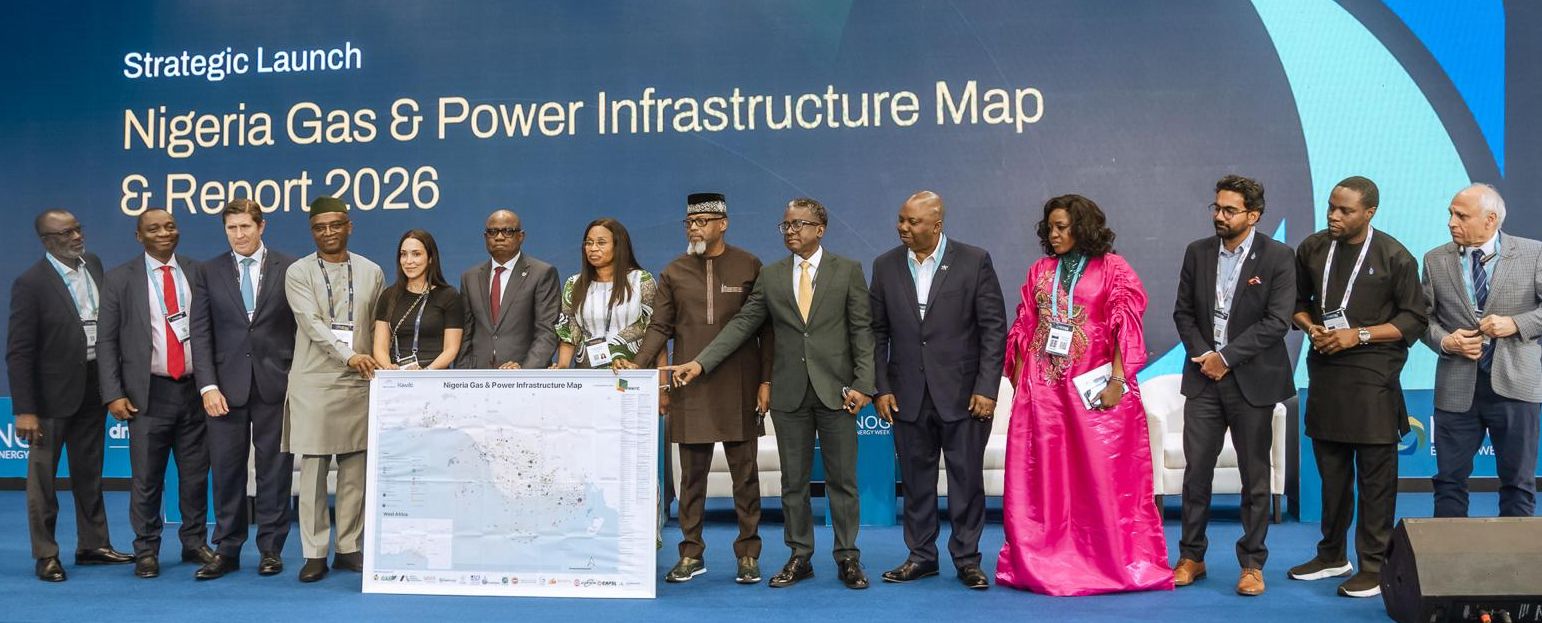
By Johnson Emmanuel
The Gas for Africa programme, in partnership with the Nigerian National Petroleum Company (NNPC) Limited, has launched the Nigeria Gas and Power Infrastructure Map 2026 at the recent 25th Nigerian Oil and Gas Energy Week in Abuja. Described as the first comprehensive update of Nigeria’s gas and power infrastructure in more than a decade, the map provides a unified reference covering the upstream, midstream and downstream gas value chain, including production assets, reserves, pipelines, gas processing facilities, transmission networks, power plants, compressed natural gas (CNG) stations, liquefied natural gas (LNG) terminals and gas-based industries. Developed with support from NNPC Limited and private sector partners including Seplat Energy, ILF Engineers, Cakasa, Nipco, Powergas, Elektroon Energy, CAPSL, Morpol and Genesis Energy Group, the initiative aligns with Nigeria’s Decade of Gas, the Presidential CNG Initiative and the Gas Master Plan. Amel Grabsi, Regional Director of Gas for Africa, said: “This map gives Nigeria what every serious energy market needs: a single, credible picture of its infrastructure. It is a tool to turn investor interest into committed capital.” Engr. Bayo Ojulari, Group Chief Executive Officer of NNPC Limited, added: “Behind every pipeline, every processing plant, and every power asset on it stands an opportunity; every capacity gap is an investment case, and every unconnected infrastructure is a project waiting for a sponsor.”
DECISION HIGHLIGHT
The infrastructure map transforms Nigeria’s gas sector from fragmented physical assets into a coordinated investment landscape, reducing information barriers that often constrain capital allocation and project development.
DECISION MEMO
Infrastructure alone rarely attracts investment. Investors require credible market intelligence, visibility of existing assets and a clear understanding of where commercial opportunities exist. By consolidating Nigeria’s gas and power infrastructure into a single national reference, the initiative strengthens the informational foundation upon which investment decisions, project planning and policy formulation can be made.
The map also reflects a broader evolution in Nigeria’s gas strategy. Rather than focusing solely on expanding infrastructure, policymakers and industry stakeholders are increasingly emphasising market transparency and investment readiness. Integrating upstream reserves, transportation networks, processing facilities and downstream demand centres provides a clearer picture of the country’s energy value chain and exposes commercially viable gaps requiring private capital.
Ojulari’s observation that every infrastructure gap represents an investment opportunity reinforces a transition from state-led infrastructure expansion towards a more investment-driven development model. If regularly updated and widely adopted, the mapping initiative could improve project origination, reduce information asymmetry and accelerate implementation of the Decade of Gas agenda.
DATA BOX
- Publication: Nigeria Gas and Power Infrastructure Map 2026.
- Launch venue: 25th Nigerian Oil and Gas Energy Week, Abuja.
- First comprehensive infrastructure update in: More than 10 years.
- Coverage:
- Upstream gas assets and reserves.
- Midstream pipelines and processing facilities.
- Downstream power plants, CNG stations, LNG terminals and gas industries.
- Strategic alignment:
- Decade of Gas.
- Presidential CNG Initiative.
- Gas Master Plan.
- Key partners:
- Nigerian National Petroleum Company Limited.
- Seplat Energy.
- ILF Engineers.
- Nipco.
- Powergas.
- Elektroon Energy.
- CAPSL.
- Morpol.
- Genesis Energy Group.
WHO WINS / WHO LOSES
Winners
- Energy investors seeking bankable gas opportunities.
- Project developers and infrastructure financiers.
- Gas producers, processors and industrial users.
- Policymakers requiring credible infrastructure intelligence.
Losers
- Information asymmetry that has historically constrained project development.
- Investors relying on fragmented or outdated infrastructure data.
POLICY SIGNALS
- Nigeria is strengthening market transparency as part of its gas sector reform agenda.
- Investment promotion is increasingly supported by structured market intelligence.
- Gas development policy is shifting from infrastructure expansion towards coordinated ecosystem planning.
- Public and private sector collaboration is becoming central to energy sector development.
INVESTOR SIGNAL
The infrastructure map improves investment visibility across Nigeria’s gas value chain by identifying existing assets, capacity gaps and potential projects. Greater transparency could enhance investor confidence, improve project origination and support increased capital deployment into gas processing, transmission, storage, power generation and industrial gas utilisation.
RISK RADAR
The value of the mapping initiative will depend on continuous updates, data accuracy and its integration into investment planning. Persistent regulatory uncertainty, financing constraints, infrastructure security challenges and delays in project execution could limit the conversion of identified opportunities into commercially viable investments.
Discover more from StakeBridge Media
Subscribe to get the latest posts sent to your email.