

By Johnson Emmanuel
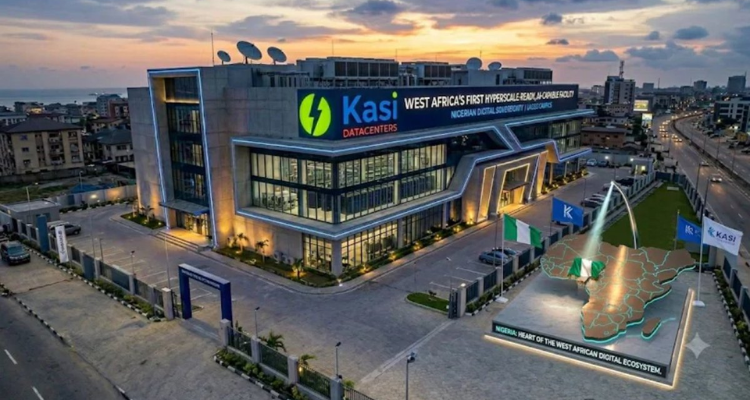
Kasi Cloud commissioned the first phase of its planned 100-megawatt artificial intelligence-ready hyperscale data centre campus in Lekki, Lagos, marking one of Nigeria’s largest private-sector investments in local digital infrastructure and compute capacity.
The project, estimated at approximately $250 million, began construction after groundbreaking activities in April 2022, with major deployment works commencing in the second quarter of 2023. The first operational rollout includes a 5.5-megawatt data hall and a 7.5-megawatt ecosystem floor designed for colocation, cloud hosting, storage and networking services.
Founder and Chief Executive Officer, Johnson Agogbua, stated that the project was designed to reduce Africa’s dependence on foreign-hosted infrastructure while supporting artificial intelligence workloads and cloud-based systems locally.
“What we are most proud of is the role that our people and our team have played,” Agogbua said. “Almost every other data centre built here was designed by others for us. Kasi is Nigeria proper. Africa proper.”
Global Director, Marketing and Sales Operations, Ngozika Agogbua, stated that Africa currently controls less than one percent of global compute capacity despite becoming one of the world’s fastest-growing digital markets.
“Every time an African business runs an AI workload, the data travels to a server in Europe or America,” Agogbua said. “The economic and strategic cost of that dependency is enormous and largely invisible.”
The company disclosed that the campus includes a dedicated 132-kilovolt substation capable of scaling towards approximately 100 megawatts of information-technology load while supporting hyperscale cloud operators including Amazon Web Services (AWS), Google and Microsoft.
DECISION HIGHLIGHT
Kasi Cloud’s investment reflects growing attempts by African technology firms to localise compute infrastructure, artificial intelligence processing and cloud services within the continent rather than relying predominantly on overseas digital ecosystems.
The project also signals increasing recognition that future economic competitiveness may depend not only on internet access but on domestic ownership of high-capacity computing infrastructure capable of supporting AI systems, enterprise cloud services and data sovereignty.
The emphasis on local engineering participation and internally trained technical talent further suggests a broader strategy centred on indigenous infrastructure capability development rather than externally managed deployment models.
DECISION MEMO
The significance of Kasi Cloud’s deployment extends beyond data-centre expansion into wider questions surrounding digital sovereignty, artificial intelligence economics and Africa’s long-term technological independence.
For years, African digital growth largely depended on imported infrastructure ecosystems where cloud storage, compute processing and AI workloads remained concentrated within North America, Europe and parts of Asia. While connectivity improved through mobile networks and subsea cables, core computational ownership remained externally controlled.
Kasi Cloud’s strategy therefore represents an attempt to shift Africa’s position within the digital value chain from infrastructure consumer towards infrastructure operator.
The project’s AI orientation is particularly important because global competition is increasingly moving beyond connectivity into compute dominance. Countries and regions controlling advanced compute infrastructure may ultimately possess stronger influence over AI development, data localisation and digital economic activity.
Agogbua’s repeated focus on “critical load” also reflects the scale economics involved in hyperscale infrastructure deployment. The ability to deliver stable electricity directly into high-density computing systems remains one of the central constraints confronting large-scale AI infrastructure development across emerging markets.
Equally notable is the project’s geopolitical framing. The company repeatedly linked infrastructure ownership with cultural representation, data sovereignty and economic retention, arguing that African languages, commerce and historical systems risk underrepresentation within future AI models if computational infrastructure remains externally controlled.
However, despite the scale of investment, Nigeria’s broader digital infrastructure ecosystem still faces structural limitations involving electricity reliability, fibre connectivity, policy consistency and high operating costs. Sustaining hyperscale infrastructure competitiveness will therefore depend heavily on long-term energy stability, regulatory coordination and enterprise adoption growth.
DATA BOX
- Company:
- Kasi Cloud
- Location:
- Lekki, Lagos
- Project scale:
- 100-megawatt AI-ready hyperscale data centre campus
- Estimated project value:
- approximately $250 million
- Groundbreaking:
- April 2022
- Major construction phase:
- second quarter of 2023
- First deployment:
- 5.5-megawatt data hall
- 7.5-megawatt ecosystem floor
- Dedicated infrastructure:
- 132-kilovolt substation
- Nigeria’s estimated operational data centres:
- approximately 17
- Africa’s global compute share:
- less than 1 percent
- Key executives:
- Johnson Agogbua, Founder and Chief Executive Officer
- Ngozika Agogbua, Global Director, Marketing and Sales Operations
- Strategic focus areas:
- AI infrastructure
- cloud computing
- colocation
- data sovereignty
- local engineering development
- GPU-intensive workloads
- Potential hyperscale clients:
- Amazon Web Services (AWS)
- Microsoft
WHO WINS / WHO LOSES
Who Wins:
- Nigerian and African cloud-service users
- Local AI developers and startups
- Enterprise businesses requiring domestic compute infrastructure
- Telecommunications and fibre-network providers
- Nigerian engineering and technology talent
Who Loses:
- Overdependence on foreign-hosted infrastructure
- Imported compute monopolies
- Economies lacking domestic AI infrastructure capacity
- Businesses exposed to high offshore hosting costs
- Technology ecosystems dependent solely on external processing infrastructure
POLICY SIGNALS
Nigeria’s digital-economy direction is increasingly shifting towards local infrastructure ownership, artificial intelligence deployment and data localisation capacity.
The project also reinforces growing pressure on policymakers to improve energy reliability, fibre infrastructure and regulatory certainty capable of supporting hyperscale digital infrastructure.
The emphasis on local talent development further signals rising policy relevance of technical workforce localisation within AI and cloud-computing ecosystems.
INVESTOR SIGNAL
The rapid growth of artificial intelligence and cloud adoption across Africa may strengthen long-term investment opportunities across:
- hyperscale data centres,
- fibre infrastructure,
- cloud services,
- AI infrastructure,
- enterprise storage,
- cybersecurity,
- digital logistics,
- carrier-neutral interconnection ecosystems.
The project may also position Lagos more competitively within West Africa’s emerging digital infrastructure landscape if enterprise demand continues accelerating.
RISK RADAR
Nigeria’s hyperscale infrastructure ambitions remain exposed to substantial structural and operational risks.
Key vulnerabilities include:
- unstable electricity supply,
- high energy costs,
- foreign exchange volatility,
- infrastructure financing pressure,
- cyber-security threats,
- weak fibre redundancy,
- regulatory inconsistency,
- slower-than-expected enterprise AI adoption.
Failure to sustain reliable power delivery and long-term operational efficiency could weaken the competitiveness of local compute infrastructure against established global cloud ecosystems.
Discover more from StakeBridge Media
Subscribe to get the latest posts sent to your email.