

By Kingsley Ani
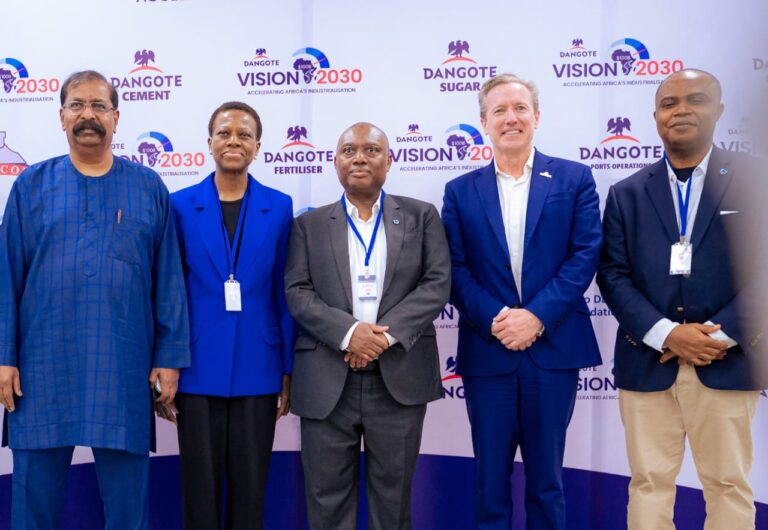
Standard Bank Group, Africa’s largest financial institution, has reaffirmed its commitment to support Dangote Industries Limited’s growth plans, including the planned Initial Public Offering (IPO) of the Dangote Petroleum Refinery and future expansion projects across Africa. The commitment was recently announced during a strategic visit to the Dangote Petroleum Refinery and Dangote Fertiliser complex in Lagos led by Standard Bank Group Chief Executive Officer, Sim Tshabalala. The visit coincided with a key operational milestone, with Managing Director and Chief Executive Officer of Dangote Petroleum Refinery, David Bird, disclosing that the refinery recently achieved performance test runs of 700,000 barrels per day, exceeding its nameplate capacity of 650,000 barrels per day.
DECISION HIGHLIGHT
Standard Bank’s endorsement transforms the refinery’s growth story from a domestic industrial success into a continental capital markets and infrastructure financing proposition.
DECISION MEMO
The significance of Standard Bank’s support lies less in the financing commitment itself and more in the validation it provides to the refinery’s long-term investment case.
Large industrial projects often face two critical tests: operational execution and investor confidence. The Dangote Refinery appears to be moving from proving operational viability to attracting institutional capital for expansion and market broadening.
Tshabalala framed the relationship within a continental context, stating: “We are here because the Dangote Group is a large and important global player and a significant force on the African continent.” His disclosure that “there is an IPO coming up and we are a leading player in that process” suggests the refinery’s future capital-raising ambitions are attracting support from major African financial institutions.
The development is notable because it signals growing confidence in African-led industrial assets as investable infrastructure platforms. Historically, large-scale African projects have often relied heavily on international development finance or foreign capital. Standard Bank’s involvement reflects increasing willingness among African financial institutions to underwrite and advise on transformative industrial projects.
The timing is equally important. The refinery has already altered Nigeria’s fuel supply dynamics and contributed to a significant decline in refined petroleum imports. Achieving test production levels of 700,000 barrels per day above the original 650,000-barrel design capacity strengthens the commercial narrative underpinning future fundraising efforts.
Tshabalala’s observation that the refinery is “already making a significant contribution to Nigeria’s economy through its impact on foreign reserves, the balance of payments and the lives of ordinary Nigerians” highlights the broader macroeconomic rationale supporting investor interest.
The planned IPO also carries wider implications for African capital markets. A successful listing would provide investors with access to one of the continent’s most strategically important industrial assets while potentially broadening ownership beyond its current shareholder structure.
The broader significance is that the refinery is increasingly being viewed not simply as an energy project but as a platform capable of attracting capital, supporting exports and anchoring industrial expansion across Africa.
DATA BOX
| Indicator | Status |
| Supporting institution | Standard Bank Group |
| Planned transaction | Dangote Refinery IPO |
| Refinery nameplate capacity | 650,000 barrels per day |
| Recent test run output | 700,000 barrels per day |
| Refinery status | Fully operational |
| Additional asset visited | Dangote Fertiliser Complex |
| Support areas | IPO advisory, financial advisory, balance sheet financing |
| Strategic focus | Expansion across Nigeria and Africa |
WHO WINS / WHO LOSES
Wins
- Dangote Refinery and expansion projects.
- African capital markets.
- Institutional investors seeking infrastructure exposure.
- Nigeria’s refining and export ecosystem.
- Financial advisory and project finance providers.
Loses
- Competing fuel import-dependent business models.
- Markets benefiting from Nigeria’s historic dependence on refined product imports.
POLICY SIGNALS
- Large-scale industrialisation is attracting institutional financial support.
- Refining capacity is increasingly linked to economic sovereignty and energy security.
- African financial institutions are assuming greater roles in financing continental infrastructure.
- Capital market participation is becoming a strategic pathway for industrial expansion.
INVESTOR SIGNAL
The support from Standard Bank strengthens the refinery’s credibility ahead of a potential public listing and signals institutional confidence in its long-term earnings potential. The combination of operational performance, import-substitution impact and export opportunities positions the refinery as a rare large-scale industrial asset capable of attracting both strategic and portfolio capital.
RISK RADAR
- IPO timing and market conditions.
- Refining margin volatility.
- Regulatory and pricing policy changes.
- Expansion execution risks.
- Global energy transition pressures.
- Foreign exchange volatility.
- Dependence on efficient logistics and distribution infrastructure.
- Concentration risks associated with a single large industrial asset.
Discover more from StakeBridge Media
Subscribe to get the latest posts sent to your email.