

By Kingsley Ani
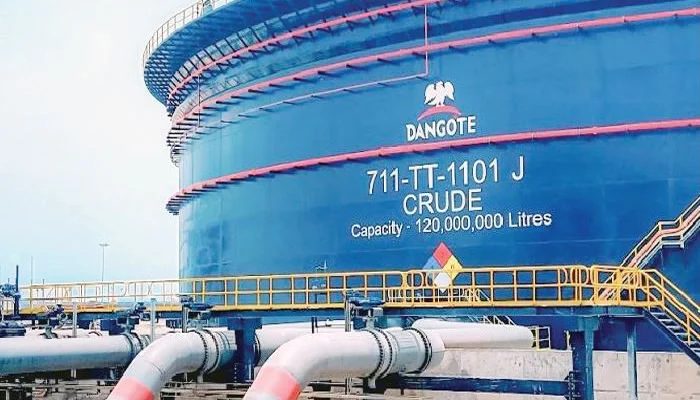
Dangote Petroleum Refinery has launched a private placement offering 3 billion ordinary shares at $0.35 per share, implying a valuation of approximately $39.1 billion. The transaction is expected to raise about $1 billion in fresh capital, with indications of interest reportedly exceeding $2 billion before the close of the offer period. The refinery, which has a processing capacity of 650,000 barrels per day and commenced petroleum product production in 2024, said proceeds will support expansion projects and general corporate purposes. Investors are required to subscribe for a minimum of one million shares valued at $350,000 and will be subject to a 365-day lock-up period.
DECISION HIGHLIGHT
The capital raise is not merely a fundraising exercise; it is a market test of whether large-scale Nigerian industrial assets can attract global capital at infrastructure-scale valuations.
DECISION MEMO
The most consequential aspect of the private placement is the valuation itself.
At $39.1 billion, the Dangote Refinery is being priced not as a conventional refinery but as a strategic energy infrastructure platform capable of reshaping regional fuel markets. The valuation reflects investor expectations that the asset will continue to benefit from Nigeria’s transition away from imported refined petroleum products while expanding exports across Africa and beyond.
The reported oversubscription interest is equally significant. Demand reportedly exceeding $2 billion for a $1 billion offer suggests that investors are increasingly willing to deploy capital into large-scale productive assets rather than limiting exposure to Nigerian sovereign debt and short-term financial instruments.
The refinery’s strategic importance stems from its scale and market position. With 650,000 barrels per day of refining capacity, it has already altered domestic fuel supply dynamics and contributed to a sharp reduction in petrol imports. This creates a revenue model anchored on both domestic demand and export opportunities, strengthening its appeal to long-term investors.
The fundraising also signals that the refinery is entering a new phase of capital formation. Initial construction risk has largely given way to operational and expansion considerations. Market expectations around logistics infrastructure, storage capacity, distribution networks and petrochemical integration suggest investors increasingly view the refinery as the nucleus of a broader industrial ecosystem.
Another important implication is capital market signalling. The transaction broadens the refinery’s shareholder base and may serve as a precursor to an eventual public listing. While no listing timeline has been announced, the private placement introduces market-based valuation discovery ahead of any future public market entry.
The broader significance extends beyond Dangote Refinery itself. The transaction is effectively a referendum on investor confidence in Nigeria’s ability to produce globally competitive industrial assets capable of generating long-term foreign currency earnings.
DATA BOX
| Indicator | Value |
| Implied refinery valuation | $39.1bn |
| Capital raise target | $1bn |
| Reported investor demand | Over $2bn |
| Shares offered | 3 billion ordinary shares |
| Placement price | $0.35 per share |
| Existing share capital | 111.67 billion shares |
| Refining capacity | 650,000 barrels per day |
| Operations commenced | 2024 |
| Minimum investment | $350,000 |
| Minimum subscription | 1 million shares |
| Investor lock-up period | 365 days |
WHO WINS / WHO LOSES
Wins
- Dangote Refinery and its expansion programme.
- Investors seeking exposure to strategic infrastructure assets.
- Nigeria’s refining and energy value chain.
- Export-oriented industrial sectors.
- Domestic fuel supply stability.
Loses
- Competing refined fuel import businesses.
- Market participants positioned around long-term import dependence.
- Regional refiners unable to compete on scale and efficiency.
POLICY SIGNALS
- Industrial-scale import substitution is attracting investor attention.
- Energy infrastructure is emerging as a major capital allocation theme.
- Nigeria’s refining strategy is increasingly becoming an export strategy.
- Private capital is playing a larger role in strategic industrial development.
- Large-scale industrial projects can attract global financing despite broader market challenges.
INVESTOR SIGNAL
The transaction suggests growing investor appetite for productive assets with clear cash-flow visibility, domestic market dominance and export potential. It also indicates that infrastructure-scale investments may increasingly compete with sovereign instruments for capital allocation. A successful raise could strengthen confidence in future industrial, energy and infrastructure fundraising across Nigeria.
RISK RADAR
- Refining margin volatility.
- Global crude oil price fluctuations.
- Regulatory and pricing policy changes.
- Execution risks around expansion projects.
- Logistics and distribution bottlenecks.
- Foreign exchange volatility.
- Competition from regional refining capacity.
- Concentration risk associated with a single large industrial asset.
Discover more from StakeBridge Media
Subscribe to get the latest posts sent to your email.