

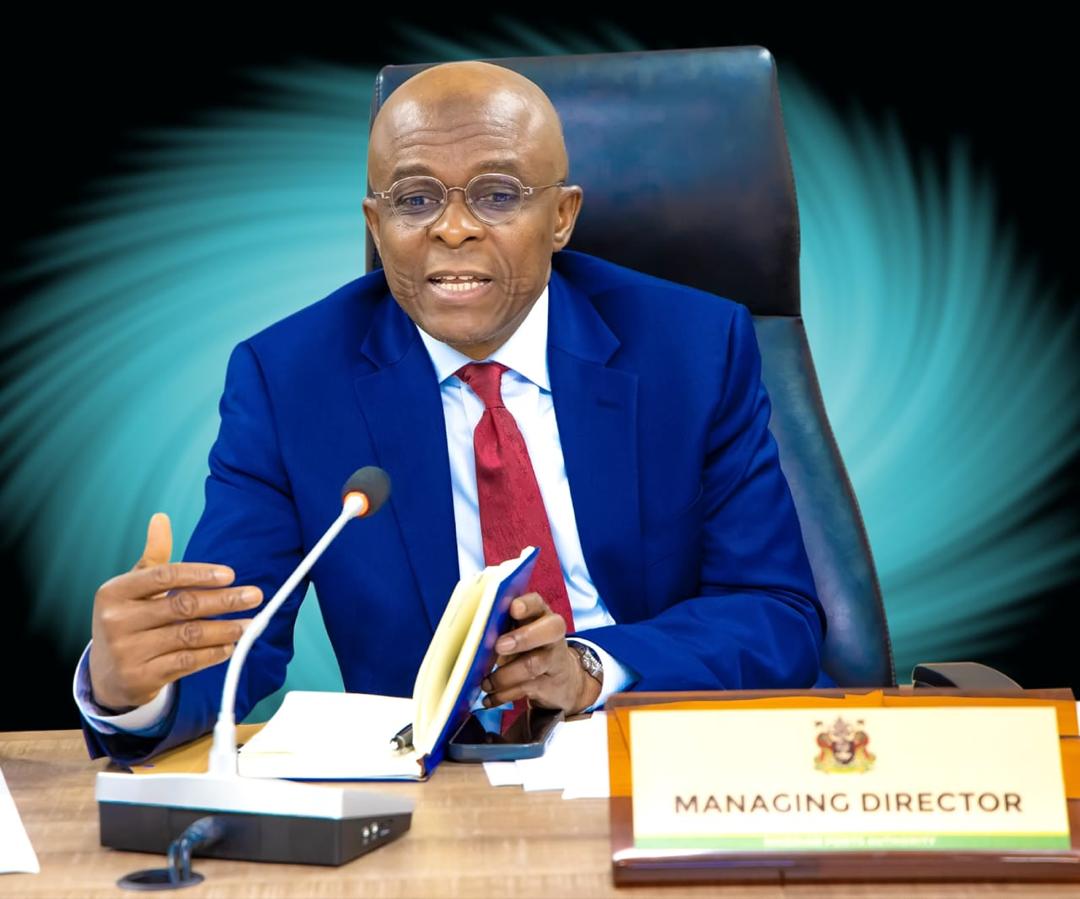
By Enam Obiosio
The Managing Director of the Nigerian Ports Authority (NPA), Dr. Abubakar Dantsoho, has recently articulated and operationalised a coordinated port reform agenda under the administration of President Bola Ahmed Tinubu, positioning Nigeria to capture African Continental Free Trade Area (AfCFTA) cargo flows through infrastructure modernisation, digitalisation, and logistics integration. While addressing industry stakeholders at a forum in Lagos, Dantsoho said that Nigeria’s port must evolve beyond their traditional limitations to compete in a rapidly integrating African market. “The time has come for a paradigm shift in the structure of Nigeria’s economy towards the full utilisation of our marine resources. Our port system, if properly harnessed, can serve as a major driver of economic growth,” he said. The federal government, through the Federal Ministry of Marine and Blue Economy led by Dr. Adegboyega Oyetola, has aligned legislative approval, including a $1 billion facility for Lagos Port Complex and Tin Can Island Port rehabilitation, with a nationwide upgrade pipeline spanning Warri, Port Harcourt, Onne, and Calabar. The mechanism is explicit: expand berth capacity, compress vessel turnaround time, deploy Port Community System and National Single Window, and integrate rail, barging, and inland dry ports to resolve hinterland frictions that have historically neutralised quay-side gains. The timing is deliberate, coinciding with AfCFTA tariff liberalisation, where throughput efficiency, not geographic inertia, determines cargo routing.
DECISION HIGHLIGHT
The NPA has prioritised a dual-track reform logic: hard infrastructure rehabilitation and soft process digitisation, underwritten by project financing openness to private capital. This is not cosmetic optimisation. It is a structural correction to decades of capacity underutilisation and process fragmentation.
DECISION MEMO
The posture adopted by Dantsoho in the NPA is instructive, if somewhat overdue. For years, Nigeria relied on scale and geography as if they were enduring competitive advantages. They are not. “The time has come for a paradigm shift in the structure of Nigeria’s economy towards the full utilisation of our marine resources. Our port system, if properly harnessed, can serve as a major driver of economic growth,” he said.
Under AfCFTA, where trade barriers are steadily being dismantled, Dantsoho warned that efficiency, not geography, will determine which countries dominate cargo flows. “Nigeria’s geographical advantage alone is no longer sufficient,” he said. “Efficiency, speed, innovation and reliability will define leadership in this new era.”
The current intervention finally recognises that ports are throughput systems, not symbols of sovereignty. Efficiency is the currency; latency is the tax.
Dantsoho’s positioning is precise. AfCFTA collapses artificial protections and exposes operational weaknesses. In such an environment, cargo is ruthlessly rational, it flows to the lowest friction corridor. The Nigerian response, therefore, shifts from rhetorical centrality to measurable performance. The introduction of a Port Community System and National Single Window is less a technological upgrade than an admission that manual opacity has been economically punitive.
Oyetola’s institutional consolidation via the Federal Ministry of Marine and Blue Economy corrects a long-standing governance defect, fragmented oversight. Coordination is not optional in logistics ecosystems; it is foundational. The ministry’s revenue expansion from N700.79 billion in 2023 to approximately N1.83 trillion in 2025 is not accidental. It reflects leakage reduction and process discipline, outcomes that should have been standard practice.
The $1 billion rehabilitation of Lagos’ primary ports addresses accumulated capital neglect. However, the more consequential move is the nationwide expansion. Concentration risk in Lagos has been a persistent bottleneck. Extending capacity to Warri, Port Harcourt, Onne, and Calabar indicates a belated understanding that network effects, not singular hubs, drive resilience.
The emphasis on multimodal evacuation is similarly corrective. Ports do not fail at the quay; they fail at the gate. Rail integration and barging are not enhancements, they are prerequisites. Without them, any gains in berth efficiency simply displace congestion inland.
Security improvements under the Deep Blue Programme, with over four years without piracy incidents, remove a non-trivial risk premium. This is one of the few areas where Nigeria has moved from liability to relative advantage.
The patronising reality is this: Nigeria is not innovating here; it is catching up. But within that constraint, the execution discipline emerging from the NPA under Dantsoho is, at minimum, directionally competent.
DATA BOX
- Over 90 percent of Nigeria’s cargo handled via ports
- Nigeria holds over 60 percent of West Africa GDP but only about 25 percent cargo share
- N700.79 billion combined agency revenue in 2023
- Approximately N1.83 trillion in 2025
- $1 billion approved for Lagos port rehabilitation
- Over 4 years without piracy incidents
- Estimated $3 trillion blue economy potential
- 823 kilometres coastline
WHO WINS / WHO LOSES
Winners: Export-oriented manufacturers, terminal operators aligned with digital systems, logistics firms with multimodal capabilities, and sovereign revenue channels benefiting from reduced leakages.
Losers: Informal intermediaries embedded in manual processes, competing regional ports reliant on Nigeria’s inefficiencies, and domestic operators unable to meet new efficiency thresholds.
POLICY SIGNALS
Clear shift from rent-seeking tolerance to throughput optimisation. Institutional consolidation suggests reduced policy fragmentation. Capital allocation signals a preference for logistics-led industrial policy rather than consumption-driven growth.
INVESTOR SIGNAL
Improving maritime security, rising agency revenues, and openness to project financing indicate a progressively investable logistics corridor. However, returns remain contingent on execution continuity and hinterland integration.
RISK RADAR
Execution slippage across non-Lagos ports, policy inconsistency, and infrastructure spillovers, especially power and inland transport, could dilute gains. Digital systems risk underperformance if stakeholder compliance is partial. The central vulnerability remains coordination failure beyond the ports themselves.
Discover more from StakeBridge Media
Subscribe to get the latest posts sent to your email.