

By Ovio Peters
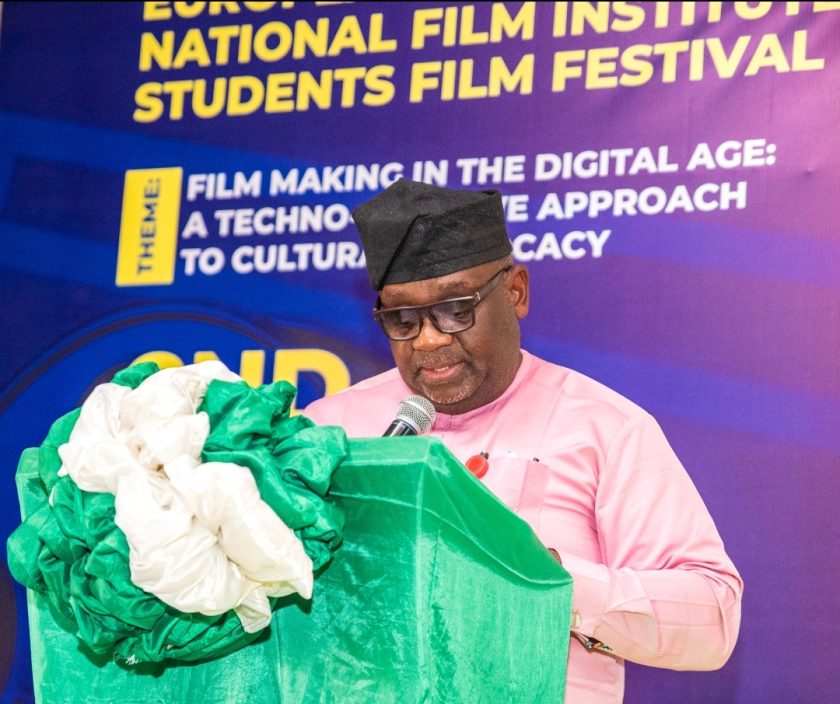
The second European Union (EU)-National Film Institute (NFI) Students Film Festival has highlighted the role of skills development, digital creativity and cultural storytelling in building Nigeria’s next generation of filmmakers. The two-day festival ended on September 29, 2026, in Jos, with student filmmakers recognised across six competitive categories.
DECISION HIGHLIGHT
The festival is more significant as a capacity-building platform than as an awards ceremony. Its combination of screenings, masterclasses and competitions creates a pathway linking technical training, cultural advocacy and opportunities for emerging filmmakers.
DECISION MEMO
Gautier Mignot, EU Ambassador to Nigeria and ECOWAS, said that the students’ work reflected a promising future for African cinema and reaffirmed the European Union’s commitment to youth creativity and capacity development.
“I am pleased with this history-making institution (NFI), where young Nigerians are being equipped with the skills to become filmmakers and to transform their experiences, communities and questions into compelling stories.”
Mignot linked the festival to EU engagements covering youth empowerment, education, culture, creative industries, people-to-people exchanges and the strengthening of EU-Nigeria relations.
Managing Director of the Nigerian Film Corporation (NFC), Dr. Ali Nuhu, described the two-day festival as more than an event, but a statement of the commitment of the NFC, NFI and EU to creating opportunities for young Nigerians to develop their storytelling capabilities.
Dr. Nuhu, in a release by Mr. Brian Etuk, Director, Public Affairs at he NFC,
said that the EU-NFI partnership was driven by a common vision and shared mission towards “building strong cross-broader and enduring cultural bridges.”
“Far too long, the struggles by our filmmakers in storytelling is seemingly ending. The rise in the number of cultural advocates and the impact they create through the stories they tell and pictures we see, assures us that the scaling of skills and competences as well as the creation of learning opportunities, especially for our emerging talents, need be sustained.”
Nuhu described the students’ performances as a testament to the quality of training at the NFI and urged them to sustain professionalism and use film as a tool for self and national development.
The awards provide a practical measure of that training pipeline. Prof. Pomak Frank Tengya, Rector of the NFI, announced the winners and assured the readiness of the institute to host the 2027 edition.
The awards went to Osakpolo Authur for Best Sound with Rev Kola; Badung Chuhwak for Best Documentary with Carrying a Legacy; Habubu Risku for Best Animation with Coming Home; Longtong Tang’an for Best Cinematography with Dusk Till Dawn; and Esther Onyinyechi Nnamani for both Best Director and Best Short Film with They Call Me Mother. Each winner received N100,000.
The institutional implication is that the festival is becoming a mechanism for converting training into visibility, professional recognition and cultural production. Its longer-term value will depend on whether those capabilities translate into sustainable careers and commercially viable creative enterprises.
DATA BOX
- Festival: September 28-29, 2026.
- Location: Jos, Plateau State.
- Award categories: six.
- Prize: N100,000 per category.
- Activities: screenings, masterclasses and competitions.
- Partnership: European Union and National Film Institute.
- 2027 edition: National Film Institute has indicated readiness to host.
WHO WINS / WHO LOSES
Emerging filmmakers gain training, exposure and recognition. The wider creative economy benefits if these capabilities generate sustainable production and employment. The unresolved challenge is the transition from institutional training to durable professional careers.
POLICY SIGNALS
Creative-sector development increasingly requires sustained talent pipelines, technical training and industry pathways rather than isolated cultural showcases.
INVESTOR SIGNAL
The commercial opportunity lies in converting improved filmmaking skills into scalable production, intellectual property, employment and exportable Nigerian content.
RISK RADAR
Training alone cannot guarantee sustainable creative businesses. Technology access, financing, professional standards, distribution and pathways from education into commercial production remain critical constraints.
Ovio Peters is a journalist, reporting on arts, creative economy, business, policy and economic developments through a sharp and analytical lens.
Discover more from StakeBridge Media
Subscribe to get the latest posts sent to your email.