

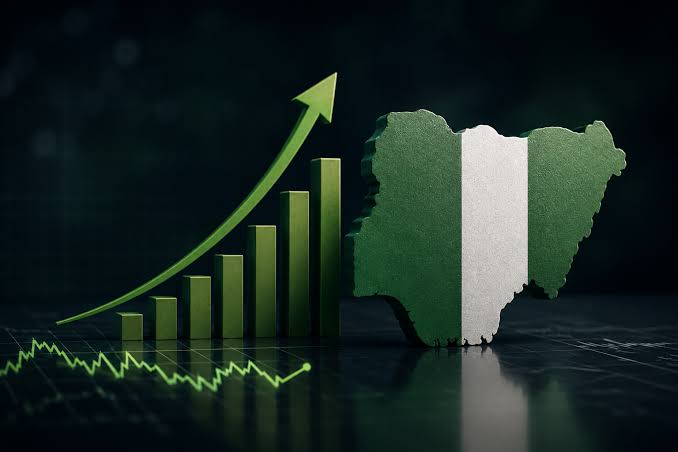
Nigeria’s economic indicators present two developments that must be examined together. External debt has risen to $54.52 billion, reflecting the country’s growing dependence on borrowing, while the October 2026 Purchasing Managers’ Index (PMI) points to a fifth consecutive month of private-sector expansion. Yet, beneath the improving business activity lies a more complicated economic reality: rising debt-service obligations, persistent production costs and uneven sectoral performance. The central question is whether Nigeria’s improving economic activity can generate sufficient productivity, revenue and fiscal capacity to sustain growth without deepening its dependence on expensive borrowing. Enam Obiosio writes.
The Debt Management Office (DMO) reported that Nigeria’s external debt increased from $43.16 billion in June 2023 to $54.52 billion by 30 June 2026, as total public debt reached N166.79 trillion. The increase mirrors a global trend identified in the World Bank’s International Debt Report 2026, which put developing countries’ external debt at a record $9.4 trillion in 2025. Separately, the Central Bank of Nigeria (CBN) reported that the country’s Composite PMI rose to 53.2 points in October 2026 from 53.0 in September, indicating a fifth consecutive month of expansion, with 24 of 32 surveyed subsectors recording growth.
DECISION HIGHLIGHT
Nigeria is recording stronger business activity while carrying a heavier debt burden. The challenge is converting economic expansion into productive capacity, higher fiscal revenue and sufficient returns to justify the cost of borrowing.
DECISION MEMO
The two developments expose the distinction between economic activity and economic resilience.
The PMI figures suggest that businesses are operating in an expanding environment. Agriculture led sectoral performance at 54.7 points, followed by services at 52.7 and industry at 52.6. Improvements in output, new orders, employment and inventories indicate that expansion is reaching several parts of the economy.
However, PMI reading above 50 indicates expansion relative to the preceding month. It does not establish the scale of actual output growth, profitability or improved household purchasing power. The moderation in services and continuing increases in input and output prices further qualify the positive picture.
The debt figures introduce the fiscal dimension. Nigeria’s external obligations have increased by approximately 26.3 percent since June 2023, while debt servicing continues to absorb substantial resources. The country paid $870.73 million in external debt service in the second quarter of 2026, with interest accounting for more than half.
The World Bank’s wider findings reinforce the concern. Developing countries paid $1.4 trillion in debt service in 2025, while the poorest economies faced some of their highest private borrowing costs in decades. Nigeria’s return to international markets through its $2.35 billion Eurobond issuance in November 2025, which attracted $13 billion in orders, demonstrates access to financing, but not necessarily the capacity to service future obligations comfortably.
This is where the two economic developments intersect. If expanding businesses generate stronger output, employment, investment and taxable income, economic activity can gradually strengthen the revenue base. But if production costs remain elevated and growth fails to translate into higher productivity, the expansion may deliver less fiscal benefit than the debt burden requires.
The real measure of recovery, therefore, is not simply whether the economy is expanding or whether Nigeria can attract creditors. It is whether productive activity can generate the earnings, tax revenue and foreign exchange needed to reduce dependence on borrowing.
Nigeria’s economic recovery will remain incomplete if business expansion does not translate into stronger productive capacity and fiscal revenue. Growth must increasingly finance its own sustainability, rather than leave the country relying on additional borrowing to meet the obligations of previous debt.
DATA BOX
- Nigeria’s external debt: $54.52 billion, June 2026.
- Total public debt: N166.79 trillion.
- External debt in June 2023: $43.16 billion.
- Second-quarter 2026 external debt service: $870.73 million.
- Developing countries’ external debt: $9.4 trillion in 2025.
- Nigeria’s October 2026 Composite PMI: 53.2 points.
- Agricultural PMI: 54.7 points.
- Industrial PMI: 52.6 points.
- Services PMI: 52.7 points.
- Expanding subsectors: 24 out of 32.
WHO WINS / WHO LOSES
Expanding agricultural and industrial businesses stand to benefit from improving demand and operating activity. Creditors earn returns from sovereign borrowing, while taxpayers and public-service beneficiaries remain exposed to the opportunity cost of debt servicing. Businesses unable to absorb rising input costs also face pressure on margins.
POLICY SIGNALS
Fiscal policy must prioritise productive expenditure, stronger revenue mobilisation and disciplined debt management. Monetary and structural policies must also address the cost constraints limiting enterprise productivity.
INVESTOR SIGNAL
The PMI expansion offers evidence of improving business conditions, while Nigeria’s borrowing activity demonstrates continued access to international capital. Investors must nevertheless distinguish economic momentum from fiscal sustainability, assessing productivity, revenue generation, debt-service capacity and foreign-exchange exposure.
RISK RADAR
The principal risk is a widening gap between the pace of borrowing and the economy’s capacity to generate sufficient returns. Persistent production costs, weak revenue mobilisation, exchange-rate volatility and refinancing pressures could constrain public investment and private-sector expansion.
Enam Obiosio is a public relations and investor relations practitioner and journalist with experience in arts and business journalism, with expertise spanning financial markets, economic policy, infrastructure, corporate communications, and the creative economy.
Discover more from StakeBridge Media
Subscribe to get the latest posts sent to your email.