

By Olumide Johnson
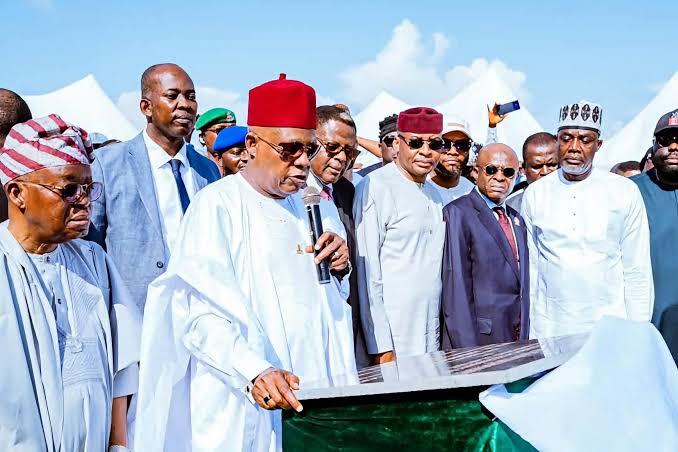
President Bola Ahmed Tinubu, represented by Vice-President Kashim Shettima, on Friday flagged off construction of the $3.5 billion Bakassi Deep Seaport in Cross River State. The project, backed by the African Export-Import Bank (Afreximbank) and structured under a public-private partnership (PPP), is designed to accommodate ultra-large container vessels and serve Nigeria, the Gulf of Guinea and landlocked West and Central African countries. Dr Abubakar Dantsoho, Managing Director of the Nigerian Ports Authority (NPA), outlined its regional trade potential, vessel capacity and supporting transport infrastructure. Cross River State Governor, Bassey Otu, Minister of Marine and Blue Economy, Dr Adegboyega Oyetola, and Afreximbank President and Chairman of the Board of Directors, Dr George Elombi, also endorsed its economic significance. Separately, Oyetola directed the NPA, terminal operators and the Nigeria Customs Service (NCS) to expedite the evacuation of electricity equipment that has remained stranded at Nigerian ports since 2007, following a presidential directive.
DECISION HIGHLIGHT
The NPA is demonstrating an increasingly strategic role in Nigeria’s maritime transformation, combining port infrastructure development, regional trade integration, operational efficiency and inter-agency coordination. Dantsoho’s contribution is particularly significant because it connects infrastructure investment with the commercial realities of international shipping and logistics.
DECISION MEMO
The Bakassi Deep Seaport represents an important opportunity to correct a structural weakness in Nigeria’s maritime economy: excessive concentration of international trade through a limited number of gateways.
Tinubu captured this challenge when he observed: “When over 80% of our foreign trade flows through Lagos, and Lagos alone, that is not strength. That risks congestion: ships queueing, goods delayed, and prices rising in the markets of Calabar, Onitsha, and Maiduguri.”
His declaration that “This project is not against Lagos. It is for Nigeria” establishes an important national development principle. Maritime expansion should complement existing ports while distributing trade opportunities more efficiently across the country.
However, the strongest institutional contribution to the discussion came from Dantsoho, whose intervention explained the commercial mechanics behind the proposed investment. The ability to accommodate ultra-large container vessels could improve shipping economies, reduce dependence on frequent maintenance dredging and strengthen Nigeria’s competitiveness in international logistics.
His identification of Chad, Niger, Mali and Burkina Faso as potential markets is particularly important in that referring to their combined population of approximately 101 million, he stated: “The Bakassi Deep Sea Port therefore presents an important opportunity to strengthen regional trade connectivity, facilitate access to international shipping routes and position Nigeria as a preferred maritime gateway for the wider West and Central African markets.”
This is a significant shift in perspective: Nigeria’s ports should not merely serve domestic imports and exports but compete for regional transit cargo and international shipping business.
The proposed evacuation highway is consequently indispensable. Tinubu referred to a 260-kilometre corridor, while Dantsoho cited a dedicated 275-kilometre, six-lane Calabar-Ogoja-Gakem superhighway. The difference in the reported measurements requires clarification, but both interventions recognise that port capacity without dependable inland connectivity cannot deliver its full economic value.
Dantsoho also is in the spotlight for connecting Bakassi with the modernisation of Nigeria’s existing Western and Eastern ports. His position reflects an appreciation that national maritime competitiveness requires coordinated investment, technology, operational efficiency and improved vessel-handling capacity, rather than isolated infrastructure projects.
The project’s historical significance is equally important. Governor Otu recalled that political, administrative, legal and environmental bottlenecks had repeatedly frustrated its implementation. He acknowledged: “Arising from these hurdles, our hope of realising the project was dim, until President Tinubu took over the mantle of leadership of Nigeria.”
President Tinubu also recognised the governor’s contribution, noting that the initiative had drifted until Otu revived it and secured the necessary institutional and financial support. He recalled that the state formalised a PPP in February 2025.
Oyetola’s intervention reinforces the Federal Government’s wider maritime development agenda. He described the groundbreaking as the beginning of a new phase in Nigeria’s maritime development, economic diversification and regional competitiveness. His emphasis on productive investment, modern infrastructure and private-sector participation provides the necessary policy context for Bakassi.
Afreximbank’s participation also gives the project a continental trade dimension. Elombi, represented by Executive Vice-President for Intra-African Trade and Export Development, Kanayo Awani, identified its potential to strengthen maritime corridors, increase cargo-handling capacity and facilitate intra-African commerce under the African Continental Free Trade Area framework.
Beyond new infrastructure, however, the NPA’s operational responsibilities remain equally consequential. Oyetola’s directive concerning electricity equipment stranded at ports for nearly two decades exposes the economic cost of administrative delays and institutional fragmentation. His instruction requires the NPA and terminal operators to coordinate cargo positioning and handling with Customs and the Federal Ministry of Power. The Minister emphasised that seaports should serve as gateways for economic growth and infrastructure delivery, not holding points for equipment needed for national development.
This is where Dantsoho’s leadership must be judged on two complementary fronts: helping deliver future maritime capacity while ensuring that existing port infrastructure works efficiently today.
Shettima’s contribution at the sixth African Sub-Sovereign Governments Network Investment Conference 2026 further reinforces this institutional responsibility. He argued that national development strategies must translate into investments, infrastructure and employment at subnational levels, adding: “National policies and continental frameworks provide direction, but their success depends significantly on what happens at the sub-national level.”
His call for states to develop investment-ready projects and attract private capital directly complements the economic rationale behind Bakassi.
Tinubu estimated that Nigeria could generate as much as $44 billion annually from the blue economy by capturing a greater share of regional maritime cargo. That ambition is substantial, but its realisation will depend on effective execution, commercially viable operations and sustained investor confidence.
DATA BOX
- Bakassi project investment: $3.5 billion.
- Financing institution: Afreximbank.
- Delivery structure: Public-private partnership.
- Proposed vessel capacity: Ultra-large container vessels.
- Supporting highway: 260 kilometres in Tinubu’s account; 275 kilometres in Dantsoho’s.
- Target regional population: Approximately 101 million.
- Projected blue economy opportunity: $44 billion annually, according to Tinubu.
- Stranded electricity equipment: Some containers at ports since 2007.
- Historical project milestones: Environmental and Social Impact Assessment completed in March 2015; PPP formalised in February 2025.
WHO WINS / WHO LOSES
Cross River State, Nigerian exporters, shipping companies, logistics operators, manufacturers and neighbouring landlocked economies stand to benefit. Consumers could gain from improved logistics and reduced congestion. Inefficient port operators and businesses dependent on administrative bottlenecks risk losing commercial advantages.
POLICY SIGNALS
Federal-state coordination, port modernisation, efficient customs administration, cargo evacuation, maritime technology and multimodal transport infrastructure must remain priorities. The NPA must sustain its institutional leadership across both new and existing port facilities.
INVESTOR SIGNAL
Bakassi presents opportunities in terminal operations, shipping, warehousing, freight forwarding, industrial development and regional cargo distribution. Existing port modernisation and improved cargo clearance also offer opportunities for private-sector participation.
RISK RADAR
Financing, construction delays, highway delivery, environmental compliance, cargo commitments, stranded equipment clearance and inter-agency coordination remain material risks. Projected capacity must translate into actual commercial throughput.
Ultimately, Dantsoho’s contribution reinforces the importance of a professionally coordinated maritime system. The NPA must not only facilitate the construction of strategic ports but also ensure that Nigeria’s existing maritime infrastructure delivers the efficiency, reliability and competitiveness required to support national economic transformation.
Discover more from StakeBridge Media
Subscribe to get the latest posts sent to your email.