

By Enam Obiosio
I have long considered the hardest question in economic reform to be what happens after the statistics begin to improve. We can celebrate stronger revenues, better investor confidence and macroeconomic stabilisation, but we cannot reasonably call reform successful if vulnerable households remain trapped on the wrong side of its costs.
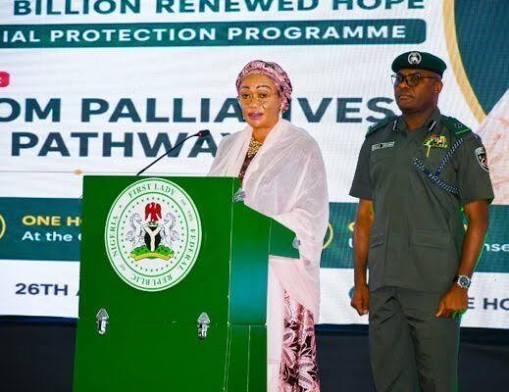
That is why I find the federal government’s $1 billion Household Prosperity and Empowerment Social Protection Project (HOPE-SP) significant. Its stated ambition is not simply to distribute assistance, but to change the architecture through which Nigeria identifies, supports and eventually graduates vulnerable households from dependence to economic participation.
Minister of Humanitarian Affairs and Poverty Reduction, Dr Bernard Doro, would put the distinction plainly: government wants to move “from reactive relief to anticipatory social protection, and from merely managing poverty to reducing it.”
I think Nigeria has never suffered from a complete absence of intervention. We have suffered from fragmentation, duplication, weak coordination and, in too many cases, inadequate measurement of what happens after assistance is delivered. Doro acknowledged that some beneficiaries can access multiple interventions while others receive none.
HOPE-SP therefore proposes a household-centred model. We identify vulnerability, assess specific needs, provide appropriate intervention and then track the household through what the government calls a “poverty graduation pathway”. That is potentially more consequential than another conventional cash-transfer programme because it introduces an expectation of progression rather than perpetual eligibility.
Senator Oluremi Tinubu captured the intended logic when she said that HOPE-SP would provide “immediate stabilisation assistance while placing the households on a pathway to recovery, empowerment and self-reliance.”
I welcome that principle, but we should also be exact about what must make it work. A pathway is meaningful only if it leads somewhere. Cash assistance can prevent immediate deprivation; it cannot by itself create a livelihood. Graduation therefore requires functioning markets, skills, access to finance, infrastructure, security and opportunities for productive employment.
This is where the broader architecture announced alongside HOPE-SP becomes important. The One-Humanitarian-One Poverty Response System is intended to coordinate interventions and unified registries. The Emergency Cash Transfer Programme provides rapid support during shocks. The Ministerial Blueprint is meant to convert the administration’s poverty-reduction priorities into measurable actions, while the Humanity First Magazine will document intervention outcomes.
I see these not as five unrelated programmes, but as an attempt to construct a more coherent social-protection system.
Senator Atiku Bagudu, Minister of Budget and Economic Planning, supplied another important dimension. Nigeria’s ambition to build a $1 trillion economy by 2030 cannot be separated from the question of who participates in that growth. His reference to the 8,809 wards is particularly relevant because poverty is experienced locally, not as an abstract national statistic. If government can identify the causes of exclusion at ward level and direct resources accordingly, social protection can become more targeted and economically productive.
Bagudu also made an uncomfortable but necessary point: Nigeria already has substantial resources devoted to social protection, including a World Bank portfolio of about $6 billion. The problem, he argued, is not necessarily the absence of resources, but whether programmes across federal, state and local governments are properly aligned and efficiently deployed. That should be the central test of HOPE-SP.
I also take seriously Governor Babagana Zulum’s argument that poverty and inequality can reinforce insecurity and instability. In communities facing prolonged humanitarian pressures, relief without economic recovery risks becoming permanent crisis management. We cannot build durable security while leaving the economic foundations of vulnerability untouched.
But we should resist judging HOPE-SP by the size of its headline funding alone. A $1 billion programme can still produce limited structural impact if beneficiary identification is weak, implementation is fragmented or graduation is measured merely by programme exit rather than sustained income and resilience.
The real measure should be whether households that enter the system eventually need less state assistance because they have acquired the capacity to withstand shocks and generate reliable livelihoods.
This is also where the government’s economic reforms must connect with its social-protection strategy. Fuel-subsidy removal and foreign-exchange reforms may strengthen public finances and investor confidence, as Doro noted, but adjustment costs are not distributed evenly. We cannot ask vulnerable households to wait indefinitely for the benefits of macroeconomic reform to reach them.
For me, the phrase “From Palliatives to Pathways” is therefore more than a communications theme. It is a policy proposition that should be tested rigorously.
We should demand transparent beneficiary data, measurable graduation criteria, independent impact assessment and clear coordination across all tiers of government. We should know not merely how many Nigerians receive support, but how many move from support to income, from vulnerability to resilience, and from dependence to productive participation.
If HOPE-SP achieves that, we will have more than another poverty intervention. We will have the beginnings of a social-protection system capable of making economic reform politically and socially sustainable.
If it does not, we will simply have replaced one form of palliative administration with another.
I believe the distinction is worth making now, before the money is spent and the numbers are celebrated.
Discover more from StakeBridge Media
Subscribe to get the latest posts sent to your email.