

By Johnson Emmanuel
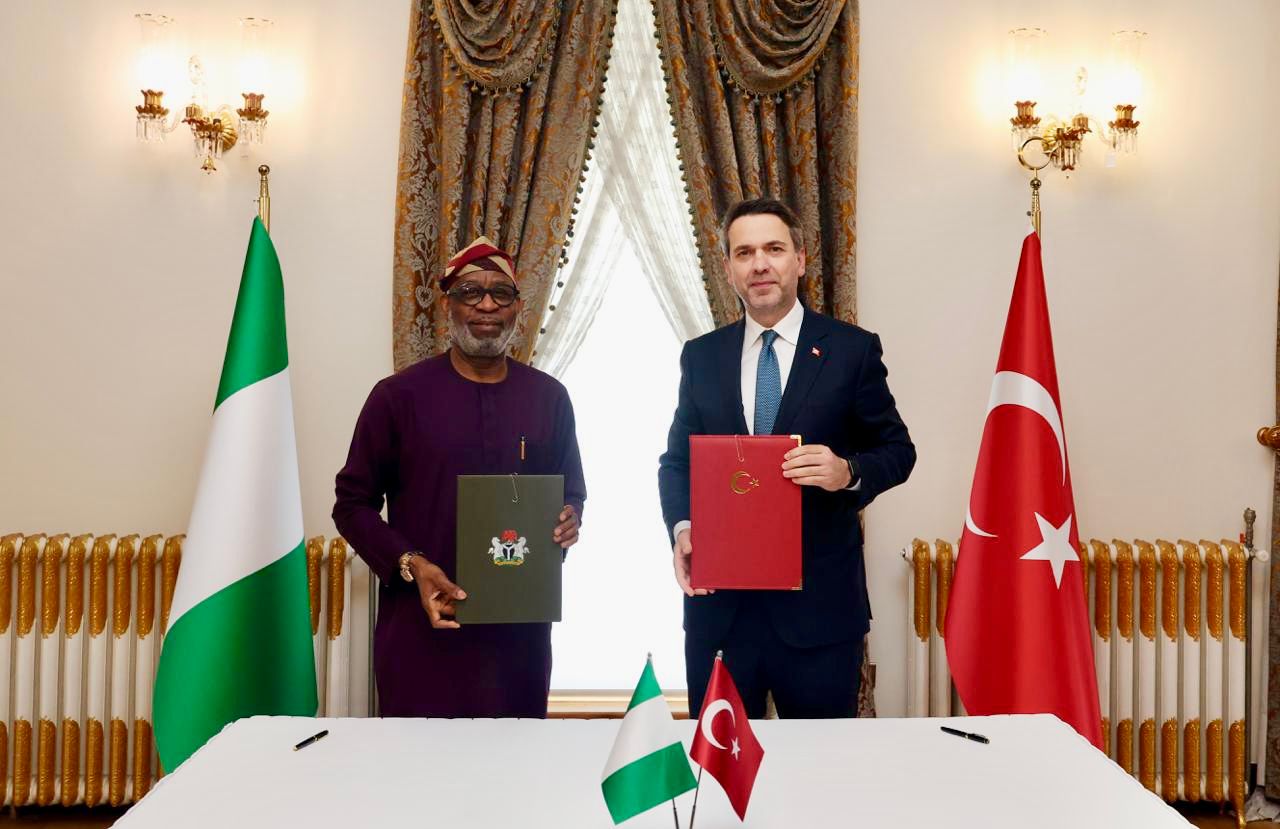
Nigeria and the Republic of Türkiye have signed a Memorandum of Understanding (MoU) to strengthen bilateral cooperation in the solid minerals sector, expanding collaboration across mining exploration, technical capacity development, digitisation, licensing systems and investment promotion.
The agreement was signed during the Istanbul Natural Resources Summit in Istanbul, Türkiye, by the Honourable Minister of Solid Minerals Development, Dr. Dele Alake, and Türkiye’s Minister of Energy and Natural Resources, Mr. Alparslan Bayraktar.
Alake said that Nigeria intends to leverage Türkiye’s technical expertise to accelerate reforms and strengthen operational efficiency within the mining sector.
“Türkiye is one of the countries we are confident of building strong bilateral cooperation with, particularly in the area of solid minerals development,” Alake stated.
He added that President Bola Ahmed Tinubu has provided full backing for expanded cooperation between both countries within the mining and energy sectors.
DECISION HIGHLIGHT
Nigeria is intensifying international mining partnerships to strengthen technical capacity, improve sector governance and attract long-term foreign investment into the solid minerals industry.
The agreement also reflects broader efforts to reposition mining as a strategic pillar within Nigeria’s economic diversification agenda.
DECISION MEMO STORY
The agreement with Türkiye reflects a broader structural transition currently underway within Nigeria’s solid minerals sector, where authorities are increasingly attempting to shift mining from a largely underdeveloped extractive activity into a more formalised investment-driven industry.
For decades, Nigeria’s mining sector remained constrained by weak regulation, illegal extraction, inadequate geological data, poor infrastructure and limited foreign investment compared with the country’s hydrocarbon sector.
The latest partnership signals increasing emphasis on technical modernisation, institutional reform and international collaboration as mechanisms for accelerating sector development.
According to Alake, reforms introduced over the past three years have improved the operating environment and increased investor confidence within the sector.
The minister stated that government measures aimed at improving ease of doing business, strengthening institutional support and permitting profit repatriation have enhanced Nigeria’s attractiveness to foreign investors.
“We have significantly improved the ease of doing business and strengthened institutional support for investors,” Alake stated.
Equally significant is the government’s growing enforcement posture against illegal mining operations.
Alake disclosed that Mining Marshals established to combat illegal extraction activities have intensified enforcement operations nationwide.
“As of the latest count, over 300 illegal mining operators, including foreign nationals, have been arrested, while more than 150 prosecutions are currently ongoing,” he stated.
The recovery of more than 100 illegal mining sites and their return to legitimate licence holders suggests authorities are increasingly prioritising asset security and regulatory credibility to restore investor confidence.
The agreement also reflects wider geopolitical and economic trends currently reshaping global mineral supply chains.
As countries seek alternative sources of strategic minerals and industrial raw materials, African mining jurisdictions are attracting renewed attention from foreign investors and industrial economies seeking long-term resource partnerships.
Türkiye’s growing interest in Nigeria extends beyond mining alone.
Bayraktar disclosed that Turkish companies are also considering expansion into Nigeria’s energy and hydrocarbon sectors, describing Nigeria as a strategic gateway for wider African economic engagement.
“We are ready to invest in Nigeria because of the remarkable initiatives your government has put in place,” Bayraktar stated.
The partnership therefore carries implications beyond bilateral diplomacy, particularly within the context of global competition for mineral access, energy security and industrial resource diversification.
Alake’s separate intervention during the summit on global peace and energy security further reflects growing recognition that geopolitical instability increasingly affects energy markets, investment flows and supply chain reliability.
For Nigeria, the broader implication is that mining sector reform is gradually becoming integrated into wider economic diversification, industrialisation and foreign investment strategy.
DATA BOX
- Agreement Type: Memorandum of Understanding
- Countries Involved: Nigeria and Republic of Türkiye
- Signing Venue: Istanbul Natural Resources Summit, Türkiye
- Nigerian Signatory: Dr. Dele Alake
- Turkish Signatory: Mr. Alparslan Bayraktar
- Cooperation Areas:
- Mining exploration
- Technical training
- Digitisation
- Licensing systems
- Capacity building
- Enforcement Metrics Highlighted:
- Over 300 illegal mining operators arrested
- More than 150 prosecutions ongoing
- Over 100 illegal mining sites recovered
- Nigerian Reform Areas Referenced:
- Ease of doing business
- Institutional support
- Profit repatriation framework
- Additional Sectors of Turkish Interest:
- Energy
- Hydrocarbons
- Strategic Institution Referenced:
- Africa Minerals Strategy Group
WHO WINS / WHO LOSES
Potential Winners:
- Foreign mining investors seeking regulated entry into Nigeria
- Nigerian mining licence holders
- Technical service providers and equipment suppliers
- Local mining communities benefiting from formalisation
- Turkish industrial and energy companies expanding into Africa
Potential Losers:
- Illegal mining networks
- Informal extraction operators
- Smuggling and illicit mineral trade channels
- Investors dependent on weak regulatory enforcement environments
POLICY SIGNALS
The agreement signals increasing government focus on mining sector formalisation, international technical cooperation and investor-driven sector restructuring.
The emphasis on enforcement and site recovery also suggests stronger institutional commitment toward lawful mining operations and asset protection.
The partnership further reflects Nigeria’s attempt to position solid minerals as a viable non-oil growth sector within broader economic diversification policy.
INVESTOR SIGNAL
For investors, the agreement reinforces growing government efforts to improve mining sector governance, regulatory clarity and operational security.
The combination of reform measures, enforcement operations and international cooperation may improve long-term confidence within Nigeria’s mining investment environment.
However, infrastructure limitations, policy consistency and security conditions remain important considerations for large-scale mining investments.
RISK RADAR
- Illegal mining persistence despite enforcement efforts
- Regulatory implementation inconsistencies
- Infrastructure and logistics constraints
- Security risks across mining regions
- Environmental and community disputes
- Commodity price volatility
- Long project development timelines and capital intensity
Discover more from StakeBridge Media
Subscribe to get the latest posts sent to your email.