

By Ayo Susan
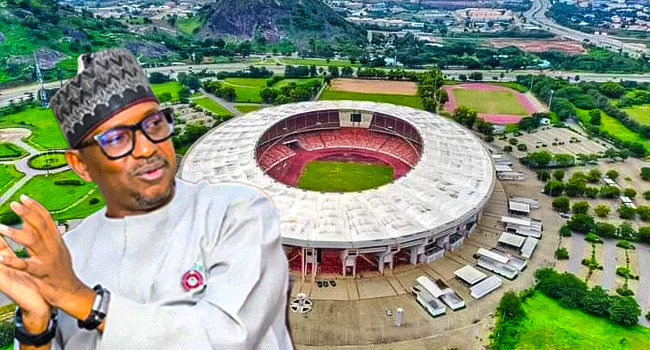
The federal government has recently approved another major redevelopment phase for the MKO Abiola National Stadium, Abuja, through the National Sports Commission, expanding ongoing efforts to reposition Nigeria’s sports infrastructure as part of a broader economic and youth development strategy.
The latest intervention includes complete renewal of the main pitch and tartan tracks, rehabilitation of dressing rooms, media facilities, VIP and corporate suites, public address and security systems, cooling and heating systems, and restoration of the stadium’s roof membrane.
Additional plans include establishment of a High Performance Centre, conversion of the 200-bed athletes’ hostel into a hotel-style facility, rehabilitation of the swimming pool, construction of two training pitches, and installation of international-standard floodlights, Video Assistant Referee technology, anti-doping laboratories and upgraded sports medical facilities.
The federal government also approved construction of 20 mini sports centres nationwide to strengthen grassroots sports development and youth engagement.
Mallam Shehu Dikko, Chairman of the National Sports Commission (NSC), stated that the project aligns with President Bola Ahmed Tinubu’s vision of using sports as a platform for “youth empowerment, economic growth and infrastructure development.”
DECISION HIGHLIGHT
The federal government is repositioning sports infrastructure from a largely ceremonial public asset into a multi-use economic and commercial ecosystem linked to tourism, talent development, youth employment and international sports competitiveness.
The redevelopment also signals increasing policy recognition that sports infrastructure can function as long-term economic infrastructure rather than solely recreational expenditure.
DECISION MEMO
The latest overhaul of the Moshood Abiola National Stadium reflects a broader shift in Nigeria’s sports policy architecture towards infrastructure commercialisation and ecosystem development.
Rather than limiting investment to stadium rehabilitation alone, the federal government is integrating hospitality, athlete performance systems, sports medicine, broadcasting infrastructure and training facilities into a more commercially scalable sports ecosystem.
The inclusion of corporate suites, hotel-style accommodation, Video Assistant Referee systems and advertising infrastructure indicates an attempt to align the stadium with international event-hosting standards capable of attracting continental and global sporting activities.
The redevelopment also reflects a continuity strategy following earlier interventions under the ‘Adopt-a-Pitch’ initiative funded by Aliko Dangote between 2020 and 2022. However, the current phase is broader in scope, moving beyond pitch rehabilitation towards full operational and commercial restructuring of the national stadium complex.
Dikko’s emphasis on youth empowerment and economic growth further highlights the government’s intention to frame sports infrastructure as a socio-economic development instrument capable of supporting job creation, tourism activity and private-sector participation.
The Director-General of NSC, Bukola Olopade, described the initiative as “a comprehensive sports ecosystem aimed at talent development, job creation, and global competitiveness.”
The simultaneous approval of 20 mini sports centres nationwide also suggests an attempt to connect elite infrastructure investment with grassroots talent development, potentially widening the pipeline between local sports participation and professional sports commercialisation.
However, the long-term economic viability of such infrastructure will depend heavily on operational sustainability, maintenance discipline, event programming and the ability to attract recurring commercial activity rather than relying solely on public financing.
DATA BOX
- Approved rehabilitation allocation in 2026: N24.6 billion
- Stadium location: Abuja
- Previous rehabilitation period: 2020 to 2022
- Previous intervention funding model: “Adopt-a-Pitch” initiative supported by Aliko Dangote
- Major upgrade components:
- Main pitch renewal
- Tartan track replacement
- High Performance Centre
- 200-bed hostel conversion
- Swimming pool rehabilitation
- Two training pitches
- Floodlights installation
- Video Assistant Referee technology
- Anti-doping laboratories
- Sports medical facilities
- Additional national infrastructure plan: 20 mini sports centres nationwide
- Lead implementing institution: National Sports Commission
WHO WINS / WHO LOSES
Winners:
- Nigerian athletes and sports federations
- Construction and facility-management companies
- Sports tourism and hospitality operators
- Youth populations targeted for sports development
- Broadcasting, advertising and event-management businesses
Potential Losers:
- Competing regional venues lacking comparable upgrades
- Public finances if maintenance and commercial utilisation weaken over time
- Existing private sports facilities facing stronger state-backed competition
POLICY SIGNALS
The redevelopment reinforces the federal government’s increasing use of sports infrastructure within broader economic diversification and youth-engagement policy frameworks.
It also signals stronger willingness to combine public investment with private-sector participation in sports infrastructure delivery and management.
The project further reflects ambition to position Nigeria as a more competitive destination for regional and international sporting events.
INVESTOR SIGNAL
The scale and scope of the redevelopment may improve investor confidence in Nigeria’s sports economy potential, particularly across hospitality, broadcasting, advertising, facility management and sports medicine segments.
The inclusion of commercial infrastructure such as corporate suites, hospitality facilities and advertising systems suggests growing recognition of sports venues as revenue-generating assets rather than purely public utilities.
However, investors will likely assess the project based on long-term operational efficiency, event-hosting consistency and sustainable commercial utilisation after construction completion.
RISK RADAR
- Cost overruns and project execution delays
- Weak long-term maintenance culture
- Underutilisation of upgraded facilities
- Limited commercial event programming
- Public-sector funding sustainability concerns
- Governance and procurement transparency risks
- Operational inefficiencies after project completion
- Revenue generation falling below infrastructure investment expectations
Discover more from StakeBridge Media
Subscribe to get the latest posts sent to your email.