

By Ayo Susan
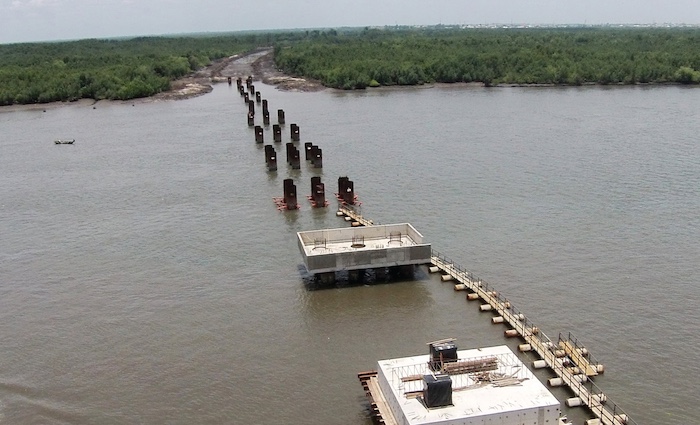
The Niger Delta Development Commission (NDDC) has accelerated work on the 3.75-kilometre Okrika-Borikiri Road and Bridge project linking Okrika and Port Harcourt Local Government Areas of Rivers State after resolving compensation issues affecting property owners along the Borikiri alignment. During an inspection visit, Martins Isichei, Assistant Director, Utilities, Infrastructural Development and Waterways at NDDC, confirmed that compensation had been paid and demolition of structures within the right-of-way would commence following resident evacuation. The project comprises three bridges, Kolabi Bridge (180m), Abotoru Bridge (1,120m) and Okpoka Bridge (490m), designed to provide an alternative transport corridor between Okrika and Port Harcourt.
DECISION HIGHLIGHT
The project’s significance extends beyond bridge construction; it represents the removal of a long-standing connectivity constraint that has limited mobility, economic integration and urban expansion within a strategic Rivers State corridor.
DECISION MEMO
The most important development is not the physical progress on the bridge itself but the resolution of a major execution bottleneck.
Infrastructure projects in Nigeria frequently encounter delays linked to compensation disputes, land acquisition challenges and community concerns. By resolving compensation issues at the Borikiri axis, the NDDC has addressed a key non-engineering risk that often undermines project delivery timelines.
Isichei underscored this turning point, noting that “the NDDC has paid compensation to property owners along the Borikiri alignment” and that work can now advance once affected residents vacate the corridor.
The project also illustrates the economic value of transport redundancy. Okrika’s dependence on existing road links has historically concentrated traffic pressure along limited access routes. Isichei stated that the completed infrastructure would “reduce traffic congestion on the refinery road and shorten travel time from Okrika to Port Harcourt,” suggesting productivity gains through lower transport costs and improved mobility.
Equally important is the project’s resilience dimension. The need to redesign portions of the bridge after a vessel collision damaged an existing pile demonstrates the operational realities of marine infrastructure development. Rather than stalling progress, the project team adapted engineering specifications to accommodate site conditions, indicating greater implementation flexibility.
Project Consultant, Azu Chukwuma, highlighted another structural factor shaping delivery, observing that “the work is mainly on the river, and much of the marine logistics involved is costly.” This reinforces the reality that successful completion will depend not only on engineering execution but also on sustained funding and logistics coordination.
From a regional development perspective, the bridge has the potential to reshape movement patterns between Okrika and Port Harcourt, expand economic access and create alternative transport channels that reduce dependence on existing road infrastructure. The project therefore represents a connectivity asset rather than merely a construction project.
DATA BOX
| Indicator | Status |
| Project length | 3.75km |
| Location | Okrika-Port Harcourt Corridor, Rivers State |
| Number of bridges | 3 |
| Kolabi Bridge | 180m |
| Abotoru Bridge | 1,120m |
| Okpoka Bridge | 490m |
| Compensation issue | Resolved |
| Current focus | Resident evacuation and right-of-way clearance |
| Key benefit | Reduced congestion and travel time |
| Major challenge | Marine logistics and waterway constraints |
WHO WINS / WHO LOSES
Wins
- Residents of Okrika and surrounding communities.
- Businesses dependent on efficient movement of goods and people.
- Port Harcourt metropolitan economy.
- Transport and logistics operators.
- Property and commercial activity along the corridor.
Loses
- Existing transport bottlenecks.
- Congestion on refinery road corridors.
- Economic costs associated with travel delays and limited connectivity.
POLICY SIGNALS
- NDDC is prioritising completion of legacy strategic infrastructure.
- Compensation resolution is being treated as a project delivery tool rather than a post-construction issue.
- Regional connectivity remains central to Niger Delta development policy.
- Infrastructure implementation is increasingly focused on unlocking economic linkages rather than isolated asset creation.
INVESTOR SIGNAL
The project signals continued public-sector commitment to transport infrastructure in the Niger Delta. Improved connectivity between Okrika and Port Harcourt could enhance commercial activity, logistics efficiency and property development potential. However, investors will focus on execution consistency, funding continuity and delivery timelines before assigning broader economic value to the corridor.
RISK RADAR
- Delays in resident evacuation and site clearance.
- High marine logistics costs.
- Construction risks associated with waterway infrastructure.
- Funding continuity risks.
- Potential environmental and operational disruptions.
- Timeline slippages arising from engineering redesign requirements.
- Dependence on sustained community cooperation throughout implementation.
Discover more from StakeBridge Media
Subscribe to get the latest posts sent to your email.