

By Olumide Johnson
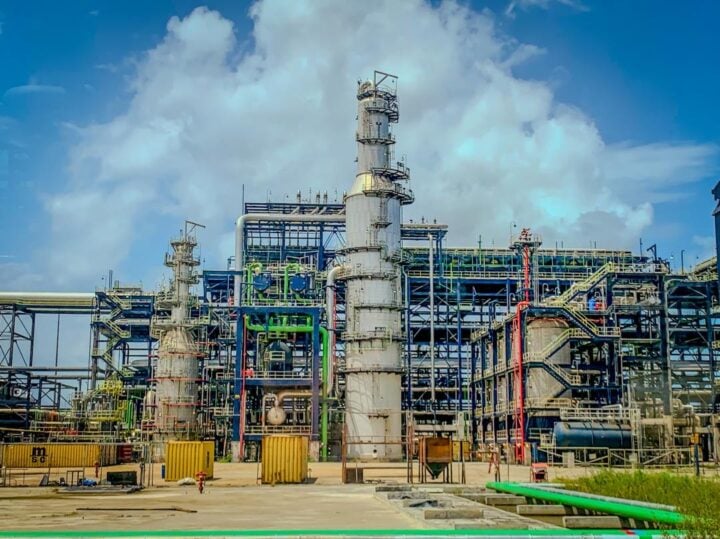
Latest first-quarter 2026 foreign trade data released by the National Bureau of Statistics (NBS) showed that Nigeria spent only N87.401 billion on Premium Motor Spirit (pms) imports between January and March 2026, compared with N2.271 trillion during the corresponding period of 2025. The decline of N2.184 trillion, representing 96.15 percent, coincided with the expansion of domestic refining capacity, particularly from Dangote Petroleum Refinery. Petrol, historically one of Nigeria’s largest import items, disappeared entirely from the country’s list of top traded products during the quarter.
The development reflects a fundamental shift in how Nigeria supplies its domestic fuel market and finances its downstream petroleum sector.
DECISION HIGHLIGHT
The key development is not merely the reduction in imports but the emergence of domestic refining as the dominant source of petrol supply.
Data from the Nigerian Midstream and Downstream Petroleum Regulatory Authority (NMDPRA) showed that locally refined petrol increasingly displaced imported supply during the review period, with Dangote Petroleum Refinery accounting for the majority of national consumption requirements.
The outcome suggests that Nigeria is gradually transitioning from a fuel-import-dependent market towards a domestically supplied refining economy.
DECISION MEMO
The first-quarter data provides one of the strongest indications yet that structural changes are occurring within Nigeria’s downstream petroleum sector.
For decades, Nigeria occupied the unusual position of being Africa’s largest crude oil producer while simultaneously remaining one of the continent’s largest petrol importers. That contradiction imposed significant pressure on foreign exchange reserves, trade balances and fiscal resources.
The collapse in petrol imports suggests that refining capacity is beginning to substitute for import dependency at a scale capable of altering national trade patterns.
Equally significant is the disappearance of petrol from Nigeria’s major import categories. This development indicates that the change is no longer marginal but increasingly systemic.
The transformation has implications beyond fuel availability. Reduced dependence on imported petrol lowers exposure to international supply disruptions, foreign exchange volatility and import financing pressures. It also increases the proportion of value retained within the domestic economy through refining, logistics, distribution and related industrial activities.
The emergence of a large-scale domestic supplier has effectively altered the structure of the market. Regulatory data indicates that Dangote Petroleum Refinery became the dominant contributor to national fuel supply during the period, substantially reducing the role previously played by imports.
The broader significance lies in the fact that refinery output is beginning to influence trade flows, import behaviour and foreign exchange demand simultaneously. Few developments in Nigeria’s energy sector have historically demonstrated such cross-sector transmission effects.
DATA BOX
- First-quarter 2026 petrol imports: N87.401 billion
- First-quarter 2025 petrol imports: N2.271 trillion
- Import reduction: N2.184 trillion
- Percentage decline: 96.15 percent
- Lowest quarterly petrol import bill since at least 2022
- Dangote Petroleum Refinery capacity: 650,000 barrels per day
- January 2026 Dangote supply: 40.1 million litres daily
- February 2026 Dangote supply: 36.5 million litres daily
- March 2026 Dangote supply: 34.2 million litres daily
- April 2026 Dangote supply: 40.7 million litres daily
- February local market share: More than 92 percent
- Total first-quarter imports into Nigeria: N13.619 trillion
- Other oil product imports: N748.10 billion, down 85.05 percent year-on-year
WHO WINS / WHO LOSES
Winners
- Domestic refiners and fuel producers.
- Foreign exchange reserves through reduced import demand.
- Local logistics, storage and distribution operators.
- Government efforts aimed at import substitution.
- The broader economy if domestic supply remains sustainable.
Losers
- International petrol exporters supplying the Nigerian market.
- Import-dependent fuel traders.
- Businesses built primarily around large-scale fuel importation.
- Foreign suppliers losing access to one of Africa’s historically largest petrol import markets.
POLICY SIGNALS
The data strengthens the policy argument for domestic value addition and import substitution.
It also provides evidence that investments in refining infrastructure can materially influence trade balances, foreign exchange demand and energy security outcomes.
The development aligns with broader government objectives around industrialisation, self-sufficiency and reducing external vulnerabilities.
INVESTOR SIGNAL
The most important signal is that refining infrastructure is beginning to generate measurable macroeconomic outcomes.
The sharp reduction in petrol imports demonstrates that domestic refining investments can reshape entire market structures rather than merely compete with imports.
For investors, this strengthens the case for opportunities across refining, petrochemicals, logistics, storage, distribution infrastructure and energy-linked industrial value chains.
The data also indicates that future growth opportunities may increasingly migrate from import intermediation towards domestic production and processing.
RISK RADAR
The sustainability of the trend remains the principal risk.
Continued reductions in imports depend on domestic refineries maintaining operational reliability, adequate feedstock supply and sufficient production volumes to meet national demand.
A second risk is market concentration. The current supply structure is heavily influenced by a single dominant refinery, creating potential exposure to operational disruptions.
A third risk involves infrastructure constraints across transportation, storage and distribution networks that must expand alongside refining output.
Nonetheless, the first-quarter figures represent one of the clearest indications in recent years that domestic refining capacity is beginning to alter Nigeria’s fuel trade architecture, with implications extending well beyond the petroleum sector itself.
Discover more from StakeBridge Media
Subscribe to get the latest posts sent to your email.