

By Hannah Yemisi
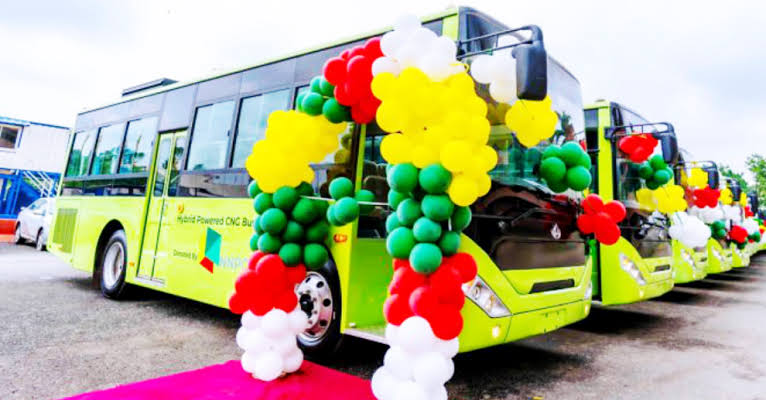
Nigeria’s drive to reduce public transportation costs through Compressed Natural Gas (CNG) and electric vehicles is moving into a wider state-level rollout ahead of the federal government’s October 1 fare-reduction target. President Bola Tinubu had directed states on September 18 to accelerate deployment of CNG and electric mass transit systems.
DEVELOPMENT
Kano, Akwa Ibom and Cross River States have already deployed 222, 50 and 10 CNG or electric buses respectively, while Ondo and Delta await 100 and 50 buses. Edo plans to unveil 50 CNG buses on October 15.
Vice President Kashim Shettima, represented in Kano by Deputy Chief of Staff, Senator Ibrahim Hadejia, said: “Transportation costs affect food prices, businesses, manufacturing, logistics and ultimately the lives of ordinary Nigerians. President Bola Tinubu understood that Nigeria could not continue to depend entirely on expensive traditional fuel systems while sitting on over 200 trillion cubic feet of gas reserves.”
Governor of Kano State, Abba Yusuf, described the initiative as a bold intervention to ease transportation challenges and create economic opportunities.
DATA
President Tinubu said that more than 120,000 vehicles had been converted to CNG, with over 400 certified conversion centres and more than 90 refuelling stations operational nationwide.
In Kaduna, Commissioner Ahmed Maiyaki said that 3.2 million passengers had benefited from free CNG transportation, saving commuters an estimated N3.5 billion. About 30 buses currently serve roughly 200 bus stops daily.
SIGNIFICANCE
The rollout is increasingly becoming an infrastructure story, not simply a bus-acquisition programme. Ondo has requested 100 CNG buses and 100 tricycles, while Special Adviser, Muyiwa Ogunyemi, said: “We requested for 100 CNG buses. We also made 100 requests for tricycles. Even though it was just a request, we don’t know if they will give us up to that.”
He stated: “The buses that governments purchase or buy, how do they cushion the effect of transportation that translates to the reduction of transportation fees?”
NEXT MOVE
The critical issue is execution. Ogunyemi said that adequate conversion workshops, trained personnel and reliable gas infrastructure are necessary. Delta is completing terminals in Asaba and Warri, while Anambra is engaging Innoson Motors and other private investors.
The National Automotive Design and Development Council is also standardising CNG and EV technician training. Its Director-General/Chief Executive Officer, Otunba Oluwemimo Joseph Osanipin, said: “Safety must remain a fundamental component of competency in these emerging technologies.”
OUR LENS
The deeper shift is from petrol-dependent mass transit towards a domestic-gas mobility ecosystem. For the policy to deliver cheaper fares, buses must be matched by conversion capacity, refuelling infrastructure, trained technicians and sustainable operating models.
As Edo Information and Strategy Commissioner, Kassim Afegbua, put it: “The buses will be near-free because of the very cheap fare that would be charged per commuter.” He stated: “The very low fare will force other public transporters to cut down on their fares.”
Hannah Yemisi is a reporter of note, governance, state government, healthcare, sustainability, agriculture, reporting on education, and social developments with a focus on accuracy, context and public relevance.
Discover more from StakeBridge Media
Subscribe to get the latest posts sent to your email.