

By Johnson Emmanuel
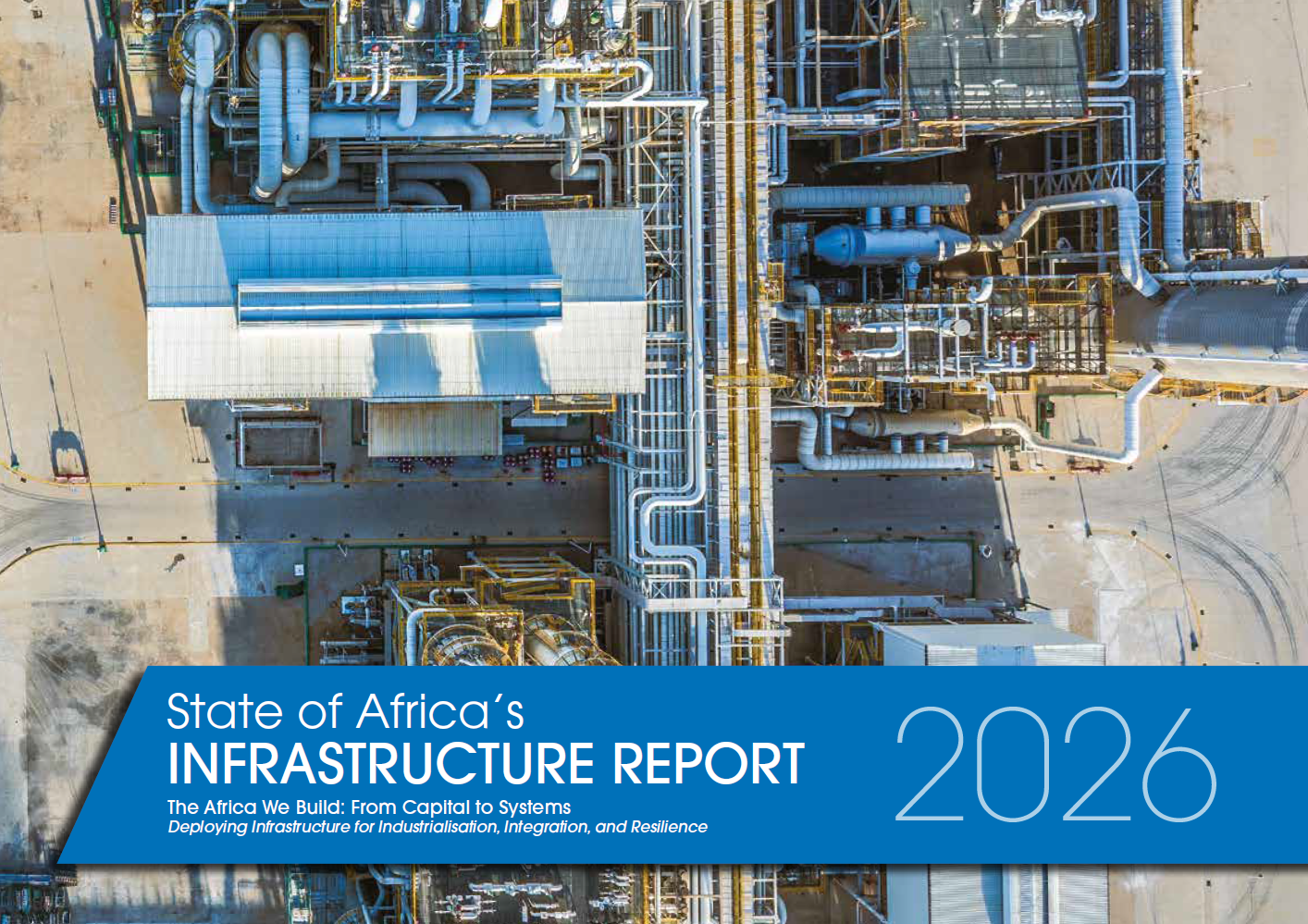
The 2026 edition of the State of Africa’s Infrastructure Report shifted its analytical focus from infrastructure as isolated assets to infrastructure as integrated economic systems required for industrialisation, trade integration and resilience across Africa. The report, titled The Africa We Build: From Capital to Systems, argued that Africa’s core vulnerability lies not in resource scarcity, but in fragmented systems that fail to convert capital, energy, logistics and digital infrastructure into scalable economic productivity.
The report stated that Africa’s challenge is no longer capital mobilisation, but capital deployment. While Official Development Assistance declined by 23.1 percent in 2025, Africa’s capital pools exceeded US$4 trillion, including more than US$1 trillion in pension and life insurance assets.
It further argued that transport corridors, energy systems, digital infrastructure and industrial value chains must operate as integrated ecosystems rather than disconnected projects. According to the report, Africa’s import basket of basic products such as fuel, food, plastics, steel and fertiliser now exceeds US$230 billion annually, exposing the continent to imported inflation and external shocks.
The report also highlighted opportunities around digital services, estimating that if Africa’s ten largest economies achieved digitally delivered services export levels comparable to Ghana’s 6.3 percent of Gross Domestic Product (GDP), annual digital exports could rise from about US$29 billion to US$127 billion.
DECISION HIGHLIGHT
The report argues that Africa’s infrastructure deficit has evolved into a broader systems and resilience deficit, requiring integrated deployment of capital, logistics, energy and digital ecosystems rather than fragmented project expansion.
DECISION MEMO
The 2026 report reflects a significant shift in African infrastructure thinking. The debate is moving away from simply building roads, ports or power plants towards constructing interconnected economic systems capable of supporting industrial competitiveness and absorbing global shocks.
Its most important conclusion is that Africa is not fundamentally capital-poor. With over US$4 trillion in capital pools and a rapidly growing working-age population, the continent’s challenge increasingly lies in weak deployment systems, shallow domestic debt markets and limited intermediation between savings and productive investment.
The report’s framing of infrastructure as “ecosystems” directly challenges the traditional project-by-project development model that has dominated African infrastructure planning for decades. In practical terms, ports without integrated rail systems, power generation without transmission integration, or broadband connectivity without enterprise platforms generate limited economic transformation despite heavy capital expenditure.
The transport and logistics findings are particularly strategic. The report suggests that Africa’s next competitive advantage may come less from building entirely new corridors and more from operationalising existing infrastructure through border efficiency, multimodal integration and coordinated corridor governance.
Similarly, the energy section reveals a transition in thinking from generation capacity expansion towards system reliability and integration. The emphasis on private transmission investment and regional power pool interconnectivity reflects growing recognition that fragmented national grids cannot support large-scale industrialisation.
The report’s value-addition argument also exposes the structural weakness of Africa’s commodity export model. By importing over US$230 billion in basic industrial products derived largely from its own raw materials, the continent effectively exports jobs, industrial capacity and inflation resilience.
The digital infrastructure analysis introduces another critical insight, connectivity alone does not create productivity. Africa’s “missing middle” problem, insufficient fibre backbones, data centres, enterprise platforms and digital service ecosystems, is now becoming one of the continent’s largest untapped investment opportunities.
Overall, the report signals that Africa’s infrastructure challenge is no longer simply physical. It is increasingly institutional, operational and systemic.
DATA BOX
- Official Development Assistance decline in 2025: 23.1 percent
• Africa capital pools: over US$4 trillion
• Pension and life insurance assets: over US$1 trillion
• Africa import basket for basic products: over US$230 billion annually
• Share of global working-age population growth to 2050: over 40 percent
• Aviation contribution to GDP across Rwanda, Kenya and Ethiopia: US$5.5 billion combined
• Jobs supported by aviation ecosystems in three countries: about one million
• Food storage capacity across Africa: below 30 percent of annual production
• Potential digitally delivered services export increase: US$29 billion to US$127 billion annually
WHO WINS / WHO LOSES
Winners:
• Integrated infrastructure and logistics investors
• Pension funds and institutional capital managers
• Regional transport and power corridor operators
• Digital infrastructure and data centre providers
• Downstream industrial processing and manufacturing sectors
Losers:
• Fragmented infrastructure systems with weak integration capacity
• Economies dependent on raw material exports without value addition
• Isolated national grids and disconnected transport networks
• Markets lacking storage, logistics and supply chain resilience
POLICY SIGNALS
- Shift from asset-based infrastructure planning towards systems integration
• Increased focus on domestic capital mobilisation and deployment
• Stronger emphasis on regional transport and energy integration
• Growing priority for industrial value addition and downstream processing
• Expansion of digital public infrastructure and enterprise ecosystems
• Greater push for private participation in transmission and logistics systems
INVESTOR SIGNAL
The report reinforces long-term opportunities in integrated infrastructure systems rather than standalone assets. Sectors linked to transmission networks, logistics corridors, data infrastructure, storage systems and industrial processing may increasingly attract institutional capital as Africa attempts to strengthen economic resilience.
However, the report also highlights execution risks linked to weak intermediation, fragmented regulation, shallow domestic debt markets and poor systems coordination. Investors are likely to prioritise markets capable of combining infrastructure expansion with institutional integration and operational efficiency.
RISK RADAR
- Fragmented infrastructure reducing economic productivity
• Weak deployment mechanisms for domestic capital pools
• High dependence on imported industrial products
• Limited storage and supply chain resilience capacity
• Shallow domestic debt markets and negative real returns
• Energy system fragmentation and transmission bottlenecks
• Underdeveloped digital enterprise ecosystems despite rising connectivity
• Delayed regional integration and corridor operationalisation
Discover more from StakeBridge Media
Subscribe to get the latest posts sent to your email.