

By Hannah Yemisi
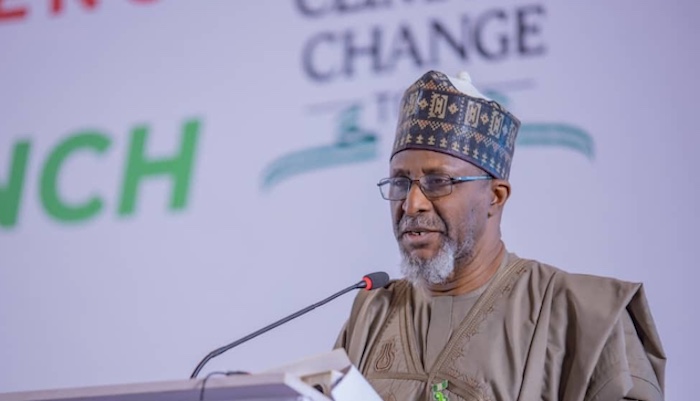
The federal government pledged support for an International Organization for Migration (IOM) initiative aimed at mobilising investment to address climate-induced migration across West and Central Africa. Honourable Minister of Environment, Mr. Balarabe Lawal, disclosed this during a regional conference in Lagos themed Migration and Climate Action in West and Central Africa: From Policy Commitment to Climate Mobility Investment.
Represented by Director of Climate Change in the ministry, Mrs. Iniobong Abiola-Awe, Lawal said that Nigeria would continue supporting efforts to bridge climate policy and financing gaps as environmental pressures intensify across the region. He identified desertification in the Sahel, coastal erosion in the Gulf of Guinea and flooding across major river basins as key drivers of displacement and migration.
Lawal stated that Nigeria’s National Adaptation Plan prioritises climate-resilient agriculture, water management, disaster risk reduction, resilient infrastructure and ecosystem-based adaptation, while also integrating migration into national climate policy frameworks.
“As widely recognised, climate change acts as a threat multiplier, intensifying vulnerabilities and influencing migration decisions,” Lawal said, adding that “mobility is not only a crisis to be managed, but also a form of adaptation and a pathway to resilience when properly harnessed.”
International Organisation for Migration Regional Director for West and Central Africa, Ms. Sylvia Ekra, said that more than two million people had already been displaced by disasters across the region, warning that up to 32 million people could be internally displaced by 2050 without effective climate action.
DECISION HIGHLIGHT
Nigeria and regional partners are increasingly reframing climate-induced migration from a humanitarian emergency into a long-term economic, infrastructure and resilience financing challenge.
DECISION MEMO
The Lagos conference reflects a growing policy shift within Africa’s climate governance framework, migration is no longer being treated solely as a border management or humanitarian issue, but as a structural economic consequence of environmental instability.
The significance of the initiative lies in its financing orientation. Rather than focusing exclusively on emergency response, the IOM-backed framework attempts to mobilise investment towards adaptation infrastructure, livelihood protection and institutional resilience systems capable of reducing forced displacement pressures over time.
Lawal’s remarks indicate that Nigeria is aligning itself with a broader international policy transition where climate mobility is increasingly recognised as an adaptive response rather than evidence of policy failure alone. This represents a departure from traditional migration narratives centred primarily on security and displacement management.
The integration of migration into Nigeria’s National Adaptation Plan also suggests that climate governance is becoming more cross-sectoral. Agriculture, water systems, infrastructure resilience and urban planning are now being linked directly to population movement dynamics and economic stability.
The projected displacement risk of 32 million people by 2050 further exposes the scale of the region’s climate vulnerability. Such movement would carry major implications for urbanisation pressure, labour markets, food systems, housing demand and public infrastructure across West and Central Africa.
The conference also highlights the increasing role of multilateral institutions and development finance actors within climate mobility governance. The European Union’s continued backing of IOM programmes indicates that migration management is becoming more deeply connected to climate finance and regional stability objectives.
However, the repeated emphasis on financing gaps reveals a core structural challenge. Many climate adaptation frameworks across Africa remain policy-heavy but capital-light. Without sustained investment in resilient infrastructure, agriculture and local economic systems, migration pressures may intensify faster than institutional response capacity.
Overall, the initiative signals that climate migration is evolving into a strategic development and investment issue rather than a temporary humanitarian concern.
DATA BOX
- Regional conference location: Lagos, Nigeria
• Organiser: International Organization for Migration
• Regional disaster displacement figure: over 2 million people
• Projected internal displacement risk by 2050: up to 32 million people
• Key climate pressures identified: desertification, flooding, coastal erosion
• Nigerian adaptation priorities: agriculture, water management, disaster risk reduction, infrastructure resilience
• Regional framework alignment: Kampala Ministerial Declaration on Migration, Environment and Climate Change
WHO WINS / WHO LOSES
Winners:
• Climate adaptation and resilience infrastructure sectors
• Development finance and climate mobility investment initiatives
• Communities accessing adaptation funding and livelihood support
• Regional institutions coordinating migration and environmental policy
Losers:
• Climate-vulnerable rural populations lacking adaptive capacity
• Economies dependent on climate-sensitive agriculture systems
• Fragile urban centres exposed to unmanaged migration pressures
• Communities affected by environmental degradation and displacement
POLICY SIGNALS
- Increasing integration of migration into climate policy frameworks
• Stronger emphasis on climate finance mobilisation
• Expansion of regional cooperation around climate mobility governance
• Growing recognition of migration as an adaptation mechanism
• Rising linkage between environmental policy and development planning
INVESTOR SIGNAL
The initiative may strengthen long-term investment opportunities in climate adaptation infrastructure, water systems, resilient agriculture, disaster management technologies and urban resilience projects across West and Central Africa.
However, the scale of projected displacement also reinforces structural risk concerns around infrastructure stress, social instability and financing adequacy. Investors are likely to prioritise projects with strong multilateral backing, measurable resilience outcomes and institutional coordination mechanisms.
RISK RADAR
- Escalating climate-induced displacement across vulnerable regions
• Weak financing capacity for adaptation programmes
• Urban overcrowding and infrastructure stress from internal migration
• Agricultural disruption linked to desertification and flooding
• Fragmented regional coordination on migration governance
• Rising humanitarian and fiscal pressures on governments
• Delayed implementation of climate resilience investments
Discover more from StakeBridge Media
Subscribe to get the latest posts sent to your email.