

By Ayo Susan
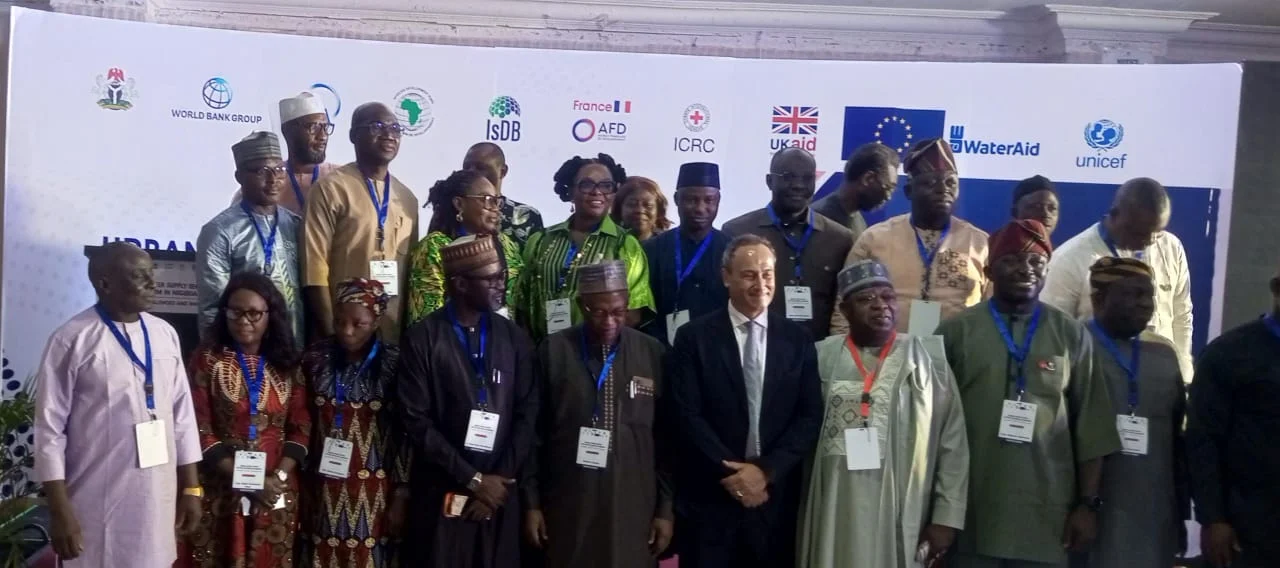
At a national workshop on ‘Urban Water Supply Sector Reform in Nigeria: Progresses, Challenges and Way Forward’ held recently in Abuja, Joseph Utsev, Honourable Minister of Water Resources and Sanitation, called for intensified reforms, increased investment and stronger partnerships to improve water and sanitation service delivery across Nigeria. The workshop, organised by the Federal Ministry of Water Resources and Sanitation with support from the World Bank, African Development Bank (AfDB), Islamic Development Bank (IsDB), European Union (EU) and Agence Française de Développement, reviewed progress, challenges and future priorities in the sector. Represented by Babarinde Mukaila, Director of Water Supply and Support Services, Utsev argued that infrastructure investment, governance reforms and coordinated stakeholder action remain essential to achieving universal access.
“Provision of quality water services remains one of the biggest challenges in many countries in Africa, and Nigeria is no exception,” Utsev said.
DECISION HIGHLIGHT
The workshop signals a policy shift from infrastructure-focused interventions towards system-wide reform centred on governance, sustainability and institutional performance.
While development financing remains significant, stakeholders increasingly agree that long-term success depends on operational efficiency, revenue sustainability, stronger institutions and coordinated sector management.
The emerging consensus is that infrastructure alone will not close Nigeria’s water access gap.
DECISION MEMO
The discussions revealed an important evolution in Nigeria’s water sector narrative.
For years, policy conversations largely focused on funding deficits and infrastructure shortages. The latest engagement suggests that attention is shifting towards how water systems are governed, operated and sustained after construction.
Utsev linked future progress to reforms and partnerships capable of addressing mounting pressures from population growth, climate variability and water scarcity.
“Concerted effort is needed through large infrastructure investments in water and sanitation, major governance and policy reforms, and an integrated approach towards sustainable water management and more importantly partnership,” he said.
The scale of the challenge remains significant. Despite decades of interventions by government and development partners, service coverage remains uneven and reliability concerns persist.
According to Utsev, approximately 30 percent of Nigerians still lack access to basic water services, while 56 percent remain without access to basic sanitation.
Development partners broadly echoed the need for a systems-based approach.
Marc Fonbaustier, Ambassador of France to Nigeria and the Economic Community of West African States, acknowledged progress achieved through reforms and investment but noted that many urban residents still depend on private boreholes, water vendors and tanker services.
“Many urban households still rely on private boreholes, water vendors, and tanker services, which are often costly, unreliable, and do not always provide safe water for domestic use,” Fonbaustier said.
Perhaps the most significant intervention came from Mahamadou Diarra, Deputy Country Director of Agence Française de Développement in Nigeria, who challenged the assumption that finance remains the sector’s primary constraint.
“Let me say it right away: the problem is not the funding,” Diarra stated.
According to him, the central challenge is sustainability.
“If we build the infrastructure alone, we have not resolved the problem. We need to have a total system that functions.”
That observation reframes the debate from capital mobilisation towards institutional effectiveness, operational management and service delivery outcomes.
DATA BOX
- Nigerians without access to basic water services: 30 percent
- Nigerians without access to basic sanitation services: 56 percent
- French water-sector investment in Nigeria over the past decade: More than €300 million
- Nigerian states supported through French interventions: Seven
- Current national programme highlighted: Sustainable Urban and Rural Water Supply, Sanitation and Hygiene Programme (2021–2028)
- Key development partners: World Bank, African Development Bank, Islamic Development Bank, European Union, United Nations Children’s Fund, Foreign, Commonwealth and Development Office, WaterAid, JICA and Agence Française de Développement
- Akwa Ibom State planned water schemes: 369 wards
WHO WINS / WHO LOSES
Winners
- Households gaining access to improved water and sanitation services.
- States implementing governance and utility reforms.
- Development finance institutions supporting sustainable infrastructure.
- Businesses dependent on reliable water supply.
- Communities benefiting from improved public health outcomes.
Losers
- Households reliant on expensive alternative water sources.
- Inefficient utilities unable to achieve operational sustainability.
- Communities exposed to unreliable or unsafe water services.
- Public investments that fail to generate long-term service delivery.
POLICY SIGNALS
The workshop signals growing policy recognition that water-sector performance depends as much on governance as on infrastructure spending.
It also reflects increasing emphasis on integrated reform models combining financing, institutional strengthening, utility performance improvement and accountability mechanisms.
The Federal Government appears to be positioning future interventions around sustainability rather than infrastructure expansion alone.
INVESTOR SIGNAL
The water sector continues to attract substantial development finance and public-sector attention.
However, the stronger signal is the shift towards performance-based investments focused on utility efficiency, revenue recovery, service reliability and institutional reform.
Future opportunities are likely to emerge in water infrastructure, utility modernisation, technology deployment, operations management and climate-resilient water systems.
RISK RADAR
The principal risk remains the gap between infrastructure delivery and sustainable service provision.
Large investments may continue to underperform if governance, maintenance and revenue collection systems remain weak.
A second risk is demographic pressure. Rapid urbanisation and population growth could outpace infrastructure expansion if reforms are not implemented at scale.
A third risk is climate variability, which increasingly threatens water availability and long-term resource management.
The workshop’s core conclusion is therefore strategic rather than financial: Nigeria’s water challenge is evolving from a question of building infrastructure to a question of sustaining functional water systems capable of delivering reliable services over time.
Discover more from StakeBridge Media
Subscribe to get the latest posts sent to your email.