

By Jennete Ugo Anya
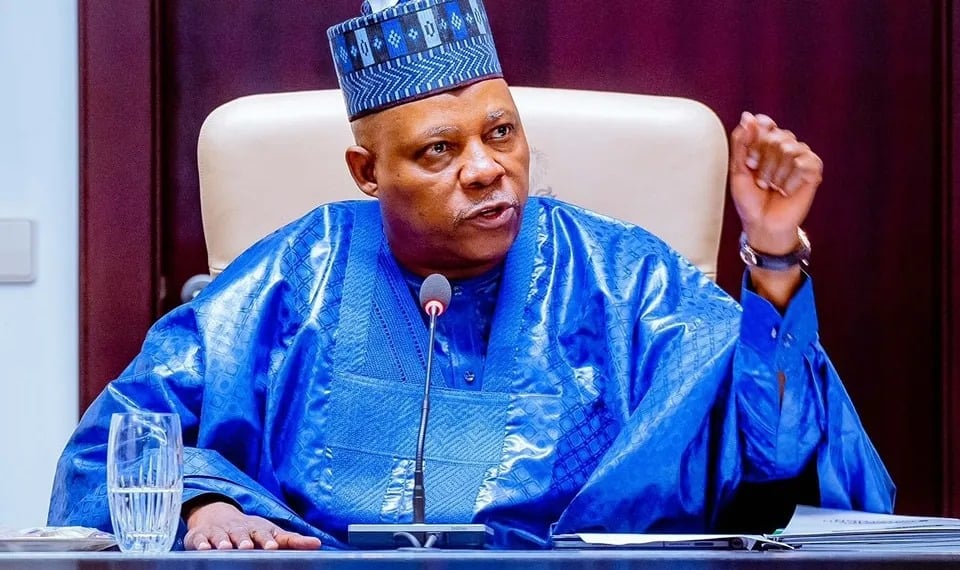
Vice President Kashim Shettima has called on state governments to take the lead in driving Nigeria’s next phase of economic expansion by converting documented assets into investment opportunities, jobs and tourism growth. Speaking recently through Dr Tope Fasua, Special Adviser to the President on Economic Matters, at the Sub-National Government Economic and Tourism Information Roundtable and launch of the National Compendium on the Economic and Tourism Profiles of the 36 States and the Federal Capital Territory in Abuja, Shettima described the compendium as a strategic tool for investment promotion, economic planning and tourism development. The initiative was supported by the Nigeria Press Council, Nigeria Governors’ Forum (NGF), Federal Ministry of Information and National Orientation, Federal Ministry of Art, Culture, Tourism and the Creative Economy, Nigerian Tourism Development Authority (NTDA) and other stakeholders.
DECISION HIGHLIGHT
The federal government is shifting economic development emphasis towards sub-national competitiveness, positioning states as the primary platforms for investment attraction, tourism expansion and job creation.
DECISION MEMO
The significance of the National Compendium lies less in documentation and more in its intended use as an investment mobilisation instrument. The initiative reflects a growing policy recognition that national economic growth increasingly depends on the ability of states to identify, package and market their comparative advantages.
Shettima, in a statement by Stanley Nkwocha, Senior Special Assistant to the President on Media and Communications, Office of the Vice President, argued that Nigeria’s challenge is not a shortage of opportunities but a failure to organise and connect them to capital. According to the Vice President, “Nigeria is rich in assets, rich in talent, rich in culture, rich in enterprise and rich in natural endowments. What we must do is organise these assets, document them properly, present them credibly, and connect them to capital, markets, technology and investors.”
His intervention reframes development from resource ownership to resource commercialisation. The implication is that states can no longer rely solely on federal allocations but must actively compete for investment through stronger institutions, better data and improved ease of doing business.
Shettima further defined the development pathway, stating: “The challenge is how to convert potential into projects, projects into investments, investments into jobs, and jobs into shared prosperity.”
Tourism emerged as a parallel growth pillar. The Vice President noted that Nigeria’s cultural and natural assets require deliberate commercial development, warning that “Tourism assets do not market themselves. They must be mapped, protected, developed, secured and linked to private investment.”
Mohammed Idris, Minister of Information and National Orientation, described the compendium as a “call to action” for states, while Hannatu Musa Musawa, Minister of Art, Culture, Tourism and the Creative Economy, represented by Abdulkarim Ozi Ibrahim, Permanent Secretary, positioned it as a platform for showcasing investment opportunities in tourism, hospitality and digital innovation.
The broader policy message is that sub-national economic performance is becoming a central determinant of national growth outcomes. The compendium therefore serves as an economic intelligence tool designed to convert state-level assets into investable opportunities.
DATA BOX
- Coverage:
- 36 states
- Federal Capital Territory
- Strategic focus areas:
- Investment promotion
- Tourism development
- Economic planning
- State competitiveness
- Priority sectors identified:
- Agriculture
- Solid minerals
- Gas
- Logistics
- Manufacturing
- Information and Communications Technology
- Tourism
- Development objectives linked to:
- Poverty reduction
- Decent work
- Industrial growth
- Innovation
- Sustainable cities
- Public-private partnerships
WHO WINS / WHO LOSES
Who Wins
- States with clearly defined investment propositions
- Tourism operators and destination developers
- Domestic and foreign investors seeking regional opportunities
- Communities benefiting from localised economic growth
Who Loses
- States unable to convert assets into bankable projects
- Jurisdictions with weak institutional capacity
- Locations that fail to improve ease of doing business and security conditions
POLICY SIGNALS
- Economic diversification is increasingly shifting to the sub-national level.
- States are being encouraged to compete for investment capital.
- Tourism is being repositioned as an economic development asset.
- Data, documentation and economic intelligence are becoming policy tools for investment attraction.
- Public-private partnerships remain central to development delivery.
INVESTOR SIGNAL
The launch of a unified economic and tourism compendium improves visibility into state-level opportunities and could reduce information asymmetry for investors. States that successfully translate documented assets into investment-ready projects are likely to attract a larger share of private capital and tourism-related investments.
RISK RADAR
- Documentation may not translate into project execution.
- Weak state institutions could limit investment conversion rates.
- Security concerns may constrain tourism development in some regions.
- Inadequate infrastructure could reduce the attractiveness of identified opportunities.
- Coordination gaps between federal and state authorities may affect implementation outcomes.
Discover more from StakeBridge Media
Subscribe to get the latest posts sent to your email.