

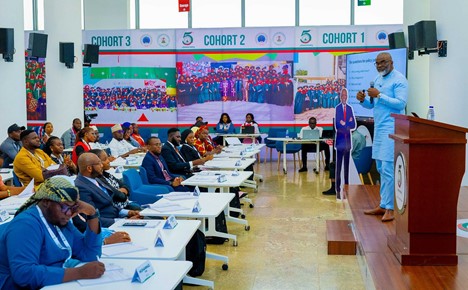
By Olumide Johnson
President Bola Ahmed Tinubu removed Nigeria’s petrol subsidy in May 2023, ending a costly fiscal intervention. In an article published on November 15, 2026, Public Policy Commentator, Patrick O. Okigbo III, assessed the reform through six policy questions at a masterclass for the fifth cohort of the Legislative Mentorship Initiative (LMI). His conclusion: removal was justified, but preparation, protection and accountability were deficient. The issue is urgent ahead of the January 2027 election, as opponents promise restoration.
DECISION HIGHLIGHT
The reform generated substantial fiscal savings, but government failed to deliver timely, visible relief. Restoring blanket subsidy would recreate fiscal distortions; retaining market pricing without reliable protection and transparent spending risks weakening public support.
DECISION MEMO
The failure lay in implementation. Tinubu tackled a fiscal drain without preparing households for higher transport and food costs.
Household pressure is evident in the cost of cooking. SBM Intelligence’s Jollof Index put a family pot of jollof rice at N10,882 in March 2023, N27,528 in June 2025, N30,435 in March 2026 and N26,178 in September. Multiple pressures contributed, but households judge reform through purchasing power.
Okigbo’s six policy tests expose the gaps. Government recognised the subsidy’s fiscal cost and regressive benefits, but underestimated who would bear the adjustment. The distortion dated to the 1970s, sustained by below-cost pricing and failed refineries. Removal could improve incentives for domestic refining, a rationale supported by the World Bank.
Removal was presented too narrowly as a choice between keeping or abolishing subsidy. Government could have prepared mass transit, transport vouchers and incentives for private investment in multimodal transport. Exchange-rate reform followed within weeks, stacking two price shocks. Decisive action did not require an unprepared transition.
Weak state capacity compromised protection. The social register was incomplete, with no reliable payment mechanism. Cash transfers began after the October 17, 2023 launch, five months after removal, then were suspended in January 2024 following a corruption investigation involving the implementing agency. Households had already cut food consumption and schooling expenditure.
Spending on a presidential jet and legislators’ SUVs contradicted shared sacrifice. No dashboard disclosed savings, spending or adjustment criteria.
The Federal Ministry of Finance reported N15.8 trillion in estimated federation savings between June 2023 and December 2025. The Federal Government’s share was N5.43 trillion, about 34 percent. Including additional revenue and borrowing, its resources totalled N20.4 trillion, against N30.64 trillion in additional expenditure pressures. The N10.24 trillion gap came from revenue. About two-thirds of additional resources went to states and local governments, making their accountability essential.
These improvements cannot be attributed to subsidy removal alone. Headline inflation fell to 14.63 percent in September 2026 from 22.41 percent in May 2023, while food inflation remained 19.59 percent. Reserves rose from $35.09 billion in May 2023 to $55.22 billion on October 30, 2026. Second-quarter growth reached 4.43 percent. Yet the World Bank put poverty at 63 percent in 2025, up from 56 percent in 2023. Aggregate recovery has not guaranteed household recovery.
DATA BOX
- Jollof Index: N10,882 (March 2023); N30,435 peak (March 2026); N26,178 (September 2026).
- Federation savings: N15.8 trillion; Federal Government share: N5.43 trillion.
- Additional resources: N20.4 trillion; expenditure pressures: N30.64 trillion.
- Poverty: 56 percent (2023); 63 percent (2025).
- Reserves: $55.22 billion, October 30, 2026.
WHO WINS / WHO LOSES
Federation finances and subnational governments gain; refiners may benefit. Poor households, commuters and food consumers bear costs where relief fails.
POLICY SIGNALS
Retain market-determined prices and prevent subsidy reintroduction through Nigerian National Petroleum Company Limited. Link household support to fuel and food price spikes. Publish monthly accounts, commission quarterly independent audits and require states to disclose receipts and spending. Legislators should legislate.
INVESTOR SIGNAL
Predictable pricing can support investment in refining, logistics and transport. Credibility depends on transparent accounts, effective safety nets and durable rules. Better indicators do not erase governance risks.
RISK RADAR
Restoring blanket subsidy would reverse fiscal gains. But retaining reform without reliable relief, public reporting and state-level scrutiny risks eroding consent and inviting reversal. The test is converting savings into public value.
Olumide Johnson is a journalist, reporting on energy, maritime, business, and developments shaping Nigeria’s economy.
Discover more from StakeBridge Media
Subscribe to get the latest posts sent to your email.