

By Olumide Johnson
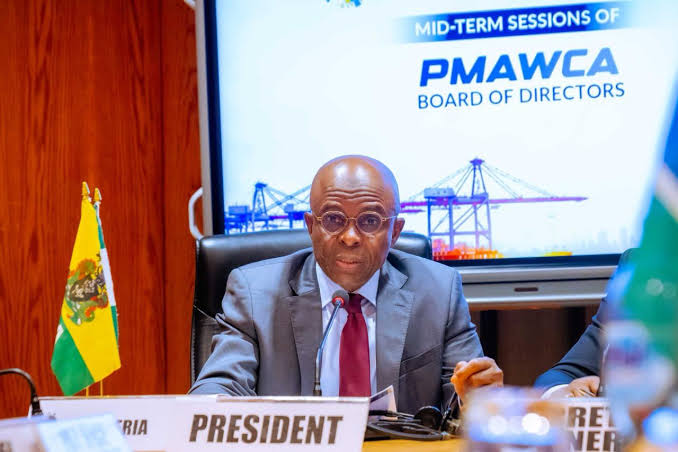
President of the Port Management Association of West and Central Africa (PMAWCA) and Managing Director of the Nigerian Ports Authority (NPA), Dr. Abubakar Dantsoho, has urged West and Central African ports to deepen cooperation, improve cargo management and reduce logistics costs. He spoke at the opening of PMAWCA’s 46th Annual Council and Joint Gulf of Guinea Commission-PMAWCA Forum in Sipopo, Malabo, Equatorial Guinea. He called for strategic collaboration over destructive competition to accelerate cargo clearance, strengthen logistics resilience and improve regional trade competitiveness.
DECISION HIGHLIGHT
Dantsoho places cooperation at the centre of maritime efficiency. Congestion at one gateway raises costs across connected economies and corridors.
DECISION MEMO
Dantsoho’s message matters because it treats ports as an interconnected economic system, not isolated national assets competing for cargo. This is essential in a region where maritime infrastructure serves coastal economies and provides international trade access for landlocked neighbours.
The Atlantic coastline from Mauritania to Angola serves about 20 coastal countries. Five landlocked countries, including Mali, Burkina Faso, Niger, Chad and the Central African Republic, depend on the efficiency of the region’s ports and transport networks. Their dependence makes port performance a shared responsibility. It recognises maritime efficiency as a regional public good, dependent on coordinated decisions and sustained, disciplined execution.
Dantsoho captured this consequence in a telling observation: “When a single port along our coast suffers congestion, it is a household or a market in Bamako, Niamey, N’Djamena, or Bangui that bears the cost.” It connects inefficiency with goods prices, supply-chain reliability and communities far from the coast.
The NPA chief used the PMAWCA’s platform to advance cooperation beyond competition for cargo volumes. Stronger neighbouring ports and dependable corridors can reinforce Nigeria’s maritime competitiveness.
West and Central African ports have undergone significant transformation over the past decade, with deep-water terminals, public-private concessions and modern infrastructure. Yet physical assets alone cannot guarantee competitiveness. Congestion, slow clearance and weak coordination can erode the value of capital already committed. Dantsoho’s emphasis directs attention to the next reform frontier: making infrastructure work as a connected network.
For the NPA, this is a leadership opportunity. Nigeria’s ports operate within a regional trading environment, and their competitiveness depends partly on connections with neighbouring gateways, inland routes and markets. Cooperation can improve planning, information exchange, cargo handling and corridor reliability, lowering costs for traders and consumers.
The call offers an alternative to destructive rivalry. Competition can encourage efficiency, but disconnected from corridor realities, it may shift rather than resolve costs. Cooperation requires shared standards, transparent coordination and recognition of mutually reinforcing trade gains.
Dantsoho has outlined cooperation as an economic necessity. The emphasis is on implementation: converting commitments into measurable improvements in clearance times, cargo movement and corridor reliability. His intervention provides direction; sustained institutional follow-through must deliver practical value.
DATA BOX
- Coastline covered: Mauritania to Angola.
- Coastal countries served: about 20.
- Landlocked countries identified: five.
- PMAWCA gathering: 46th Annual Council and joint forum.
- Infrastructure: deep-water terminals, public-private concessions and modern port facilities.
WHO WINS / WHO LOSES
Winners: Importers, exporters, consumers, port users, coastal economies and landlocked countries benefit from faster cargo movement and lower costs.
Losers: Avoidable delays, inefficient processes and fragmented coordination lose ground.
POLICY SIGNALS
Port authorities should strengthen information-sharing, align operational procedures where feasible and coordinate transport corridors.
INVESTOR SIGNAL
Predictable cargo handling and reliable regional connections can improve trade economics, support private investment and raise returns on existing infrastructure.
RISK RADAR
Cooperation will remain rhetoric without accountable targets, timelines, comparable performance data and sustained commitment from participating ports.
Olumide Johnson is a journalist, reporting on energy, maritime, business, and developments shaping Nigeria’s economy.
Discover more from StakeBridge Media
Subscribe to get the latest posts sent to your email.